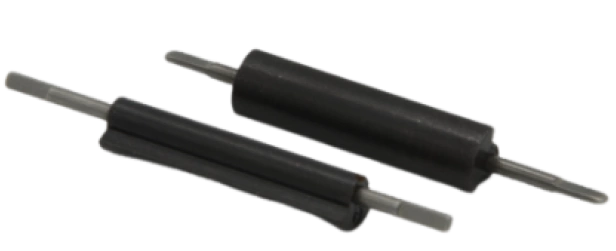


Exquisite Craftsmanship and a Rigorous Pursuit of Quality
Magnets for Automotive

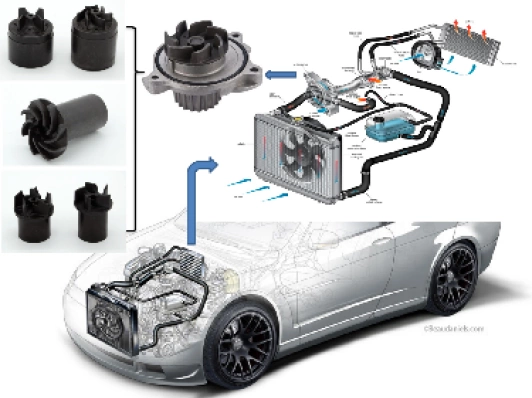
Electronic water/oil pumps, as core components, are particularly crucial in the system. The rotor made of a bonded magnetic compound has huge advantages in lightweight and quality controllability. Bonded magnetic compounds like Ferrite/PPS and NdFeB/PPS are both applied to pump rotors, and are suitable for both internal and external rotor structures. The blade and the rotor can be made by injection molding as a whole. Or you can just make the rotor part by injection molding, the blade can be made of other materials by secondary injection.

From the initial vehicle speed sensor to intelligent driving, the application of a magnetic sensor ring gains popularity. At present, rubber magnet is used as raw materials for some magnetic sensors, but the mechanical properties of rubber make it unsuitable as an exposed component (it will be deformed easily by the impact from stone, and the performance will be affected in high and low temperature). Compared with injection magnets, the magnetic properties of rubber magnets are lower ((BH) max≤1.4MGOe), which can’t meet long-range sensing needs. Bonded magnetic compounds like Ferrite with PA6 or PA12 binder can meet these requirements.
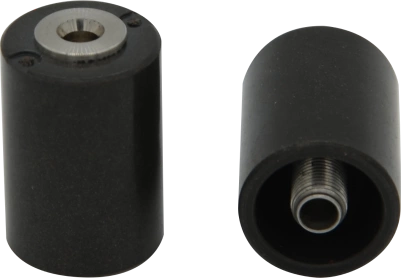
To address these challenges, injection-molded rotors made from Ferrite/PPS and NdFeB/PPS compounds prove highly effective for EEVs:
Ferrite/PPS Series:
Purpose: Ideal for low-power motors.
Magnetic Properties: Achieves a maximum energy product ((BH)max) of 1.6 MGOe.
Advantages: Cost-effective, corrosion-resistant, and demagnetization-resistant at high temperatures.
NdFeB/PPS Series:
Purpose: Suited for higher-power electronic expansion rotors.
Magnetic Properties: Yields a maximum energy product ((BH)max) ranging from 2 to 8 MGOe.
Advantages: Offers exceptional magnetic strength, enabling smaller, lighter components.
As the demand for automotive thermal management systems grows, we remain committed to developing injection-molded magnetic materials that align with the design requirements of next-generation expansion valve rotors. Our ongoing efforts focus on achieving higher magnetic properties, cost efficiency, and improved resistance to high and low-temperature demagnetization. Together, we contribute to energy conservation and environmental protection.
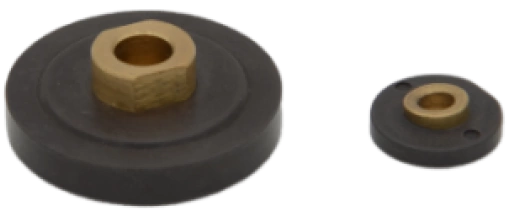
Induction Magnetic Rings in Automotive Applications
The key advantages of injection-molded magnetic rings lie in their exceptional mechanical properties and consistent dimensions including:
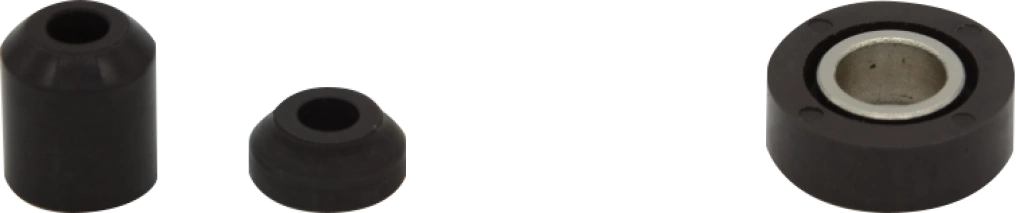
Direct Assembly on Motor Shafts: Due to the robustness of injection-molded magnets, magnetic rings can be directly assembled onto motor shafts without the risk of cracking or detachment during use.