

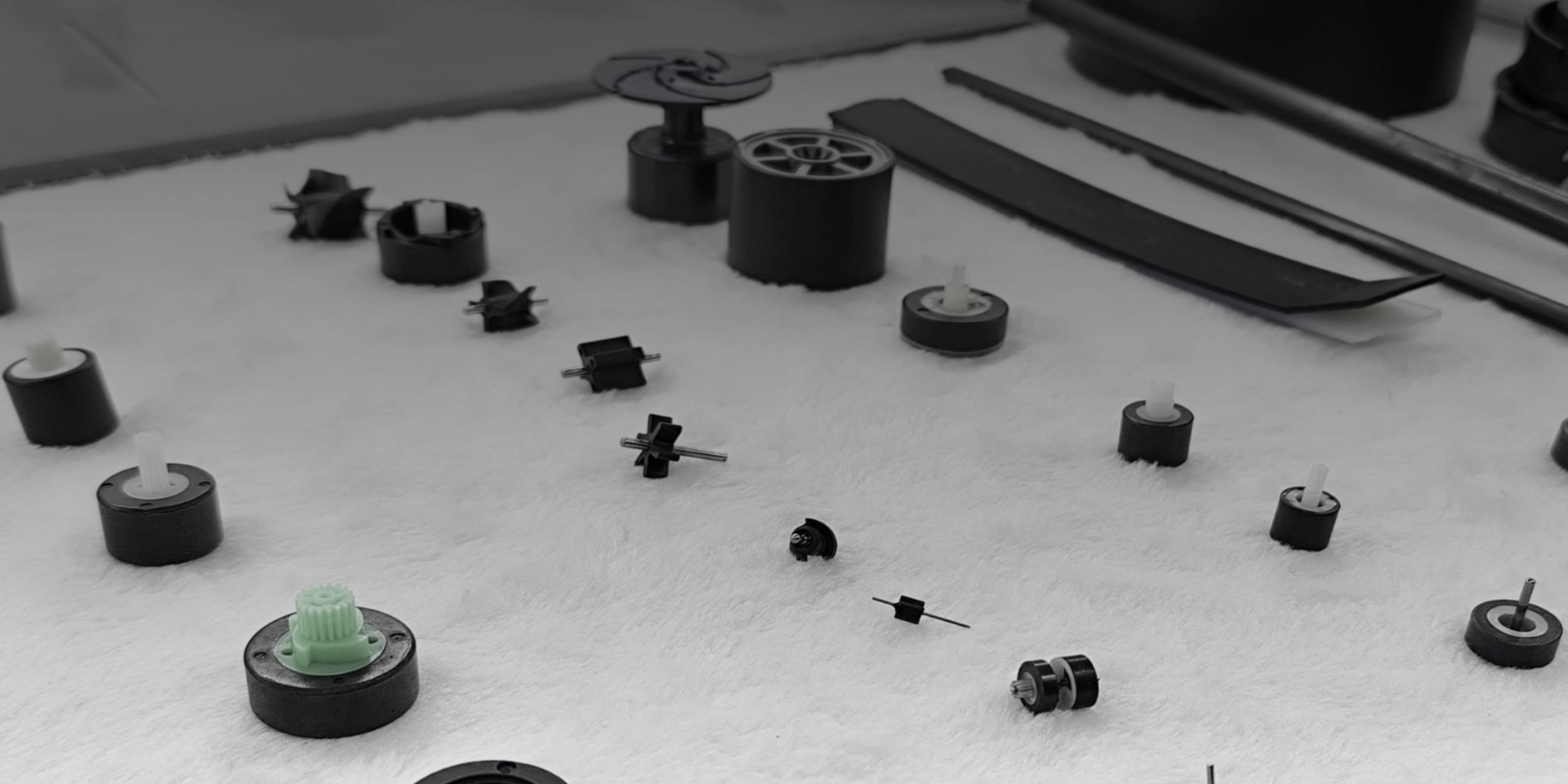
Introduction
As permanent magnet applications become increasingly sophisticated across automotive electronics, robotics, energy conversion, and industrial automation, engineers must select magnet materials based not only on magnetic performance but also on manufacturability, thermal reliability, dimensional constraints, and system-level integration.
Among modern rare-earth magnet solutions, sintered NdFeB magnets and injection molded NdFeB magnets represent two fundamentally different engineering approaches. Although both are derived from NdFeB magnetic powders, their microstructure, production processes, and resulting performance diverge sharply.
This technical paper provides a material science–based comparison to support magnet selection in advanced product development.
Material Fundamentals and Microstructure Behavior
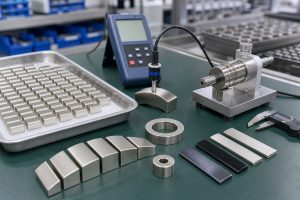
Sintered NdFeB Magnets
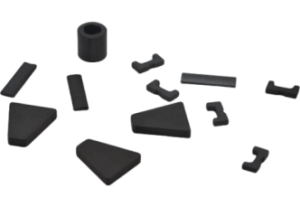
Sintered magnets are produced through a high-temperature powder metallurgy process. The powder is compacted under high pressure, aligned in a magnetic field, and sintered near 1,000°C. The result is a fully dense polycrystalline microstructure with strongly oriented grains.
Key structural characteristics:
-
Density approaching theoretical maximum
-
Highly aligned magnetic domains
-
Sharp grain boundaries providing high coercivity
-
Brittle, ceramic-like mechanical characteristics
High energy product (BHmax) values are achievable due to this microstructure, making sintered NdFeB the strongest available commercial magnet material.
Explore engineering-grade sintered options:
https://chasemagnet.com/product/sintered-magnets/
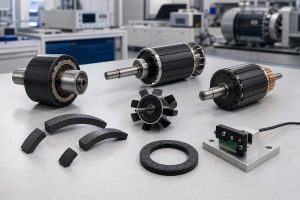
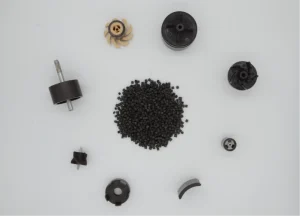
Injection Molded NdFeB Magnets
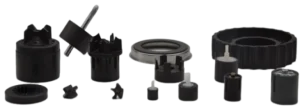
Injection molded magnets are fabricated by mixing NdFeB powder with a thermoplastic binder (PA, PPS, or similar), resulting in a composite material that can be injection molded.
Key structural characteristics:
-
Lower magnetic particle density (typically 60–80% by weight)
-
Isotropic magnetic behavior unless aligned during molding
-
High toughness and impact resistance
-
Excellent dimensional stability
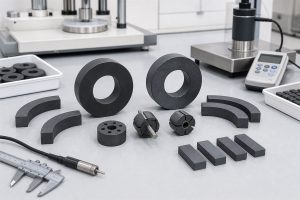
Although magnetic performance is lower due to polymer content, molded magnets enable complex geometries that cannot be achieved with sintered materials.
Learn more about engineered molded magnet solutions:
https://chasemagnet.com/product/injection-molded-magnets/
Technical Comparison Table
Below is a detailed engineering comparison:
| Technical Parameter | Sintered NdFeB Magnets | Injection Molded NdFeB Magnets |
|---|---|---|
| Microstructure | Fully dense, polycrystalline, grain-oriented | Polymer-bonded composite, isotropic or mildly anisotropic |
| Magnetic Strength (BHmax) | Very high (up to 50+ MGOe) | Moderate (5–10 MGOe depending on loading) |
| Coercivity | High; various grades for high-temperature environments | Moderate; limited by polymer thermal properties |
| Temperature Stability | Up to 200–230°C (grade-dependent) | Typically < 150°C depending on binder |
| Mechanical Strength | Brittle, low tensile strength | Tough, impact-resistant |
| Dimensional Tolerance | Requires machining; tighter tolerances possible | Very high precision from mold; consistent repeatability |
| Complex Geometry Capability | Limited; post-machining needed | Excellent; complex shapes, thin walls, over-molding |
| Corrosion Resistance | Requires coating (Ni-Cu-Ni, epoxy, etc.) | Natural resistance due to polymer matrix |
| Cost Efficiency | Higher for complex parts due to machining | Highly cost-effective for high-volume complex shapes |
| Typical Applications | Motors, generators, couplings, industrial actuators | Sensors, small motors, automotive components, mechatronics |
Manufacturing Process Analysis
Sintering: High-Density Magnetic Formation
The sintering process yields high remanence (Br) and coercivity (HcJ) due to:
-
Crystallographic alignment during pressing
-
Formation of Nd-rich grain boundary phases during sintering
-
Achieving near-theoretical density
However, post-sintering machining is unavoidable, leading to higher processing costs and increased fragility risk.
Injection Molding: Magnetic–Polymer Composites
Processing involves:
-
Blending magnetic powder with polymer binders
-
Injection molding at low thermal stress
-
Optional magnetic field alignment during mold filling
This method enables:
-
Near-net-shape components
-
Over-molding onto shafts, housings, or sensors
-
Integrated multi-component assemblies
The trade-off is lower magnetic performance due to dilution by the polymer matrix.
Engineering Selection Criteria
Choose Sintered Magnets When:
-
Maximum magnetic output is critical (motors, generators)
-
High temperature resistance is required
-
Application tolerates brittle materials
-
Mechanical machining is acceptable
Choose Injection Molded Magnets When:
-
Complex geometries or integrated magnetic assemblies are required
-
Dimensional stability is a priority
-
Lower magnetic output is acceptable
-
Mechanical robustness or impact resistance is needed
-
High-volume production benefits from low-cost molding tools
Application Case Alignment
Sintered magnet typical fields:
-
Traction motors and servo motors
-
Magnetic couplings
-
High-performance actuators
-
Aerospace and industrial automation
-
Renewable energy systems
Injection molded magnet typical fields:
-
Automotive sensors (ABS, speed, position sensing)
-
Intelligent mechatronic components
-
Precision consumer electronics
-
Micro-motors and actuators
-
Fluid control devices
Conclusion
Sintered and injection molded NdFeB magnets, though derived from the same base material, serve distinctly different engineering needs. Sintered magnets offer unmatched magnetic performance, making them indispensable in high-power systems. Injection molded magnets, on the other hand, provide exceptional design freedom, enabling complex geometries and integrated assemblies that cannot be produced through sintering.
For design engineers, selecting between the two requires an understanding of performance requirements, operating environment, mechanical constraints, and manufacturing economics.
Chase Technology provides both sintered and molded magnet solutions backed by scientific research expertise, supporting advanced system development across multiple industrial sectors.