

Magnet forming technologies define the critical transition from magnetic materials to usable magnetic products. While magnetic composition determines theoretical performance limits, forming technologies decide how much of that potential can be realized in real-world applications. They directly affect magnetic density, grain orientation, achievable geometry, mechanical behavior, and long-term reliability.
From an engineering standpoint, magnet forming methods should not be casually grouped as “sintered” or “molded” alone. A more accurate classification is based on material densification mechanisms and binder involvement, which fundamentally govern magnetic and structural outcomes.
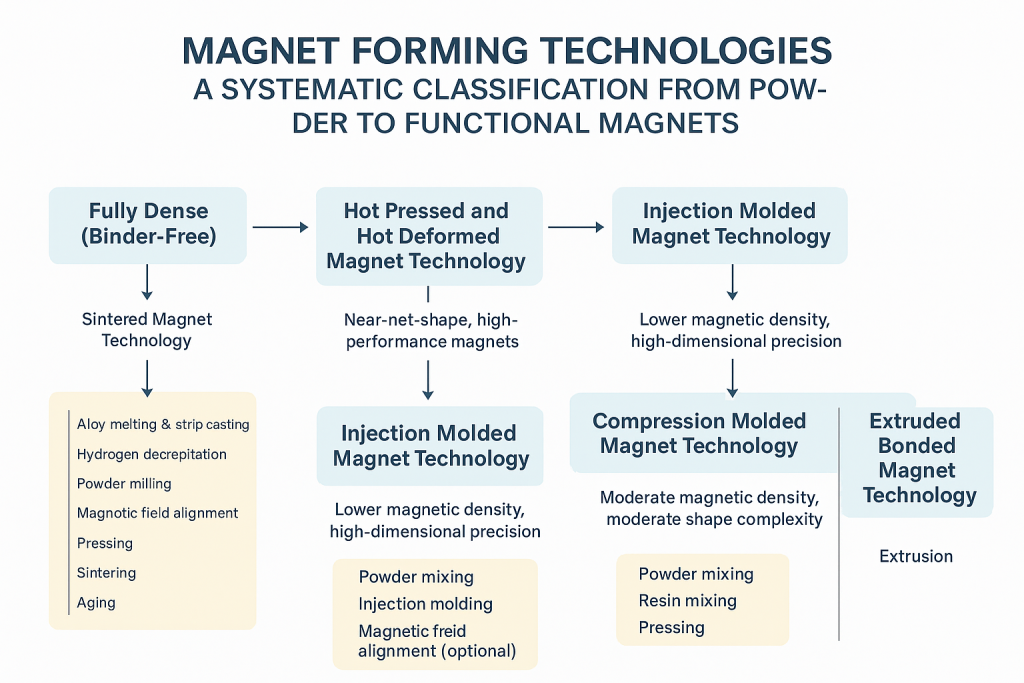
Fully Dense (Binder-Free) Magnet Forming Technologies
Fully dense magnet technologies rely on metallic bonding and high-temperature diffusion to achieve near-theoretical density. These methods produce magnets with the highest possible magnetic performance.
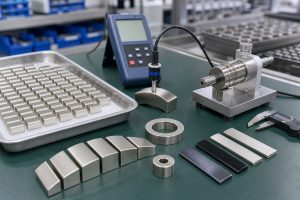
Sintered magnet technology is the most established and widely adopted approach for high-performance rare earth magnets. The process typically involves alloy melting and strip casting, hydrogen decrepitation, fine powder milling, magnetic field alignment, pressing, high-temperature sintering, and subsequent aging treatment. The resulting microstructure consists of densely packed, crystallographically aligned grains, enabling extremely high remanence and maximum energy product.
Sintered magnets are commonly referred to as sintered NdFeB magnets, powder metallurgy magnets, or rare earth sintered magnets. While these terms are often used interchangeably in industry, they all describe the same binder-free, high-density forming route. The trade-off lies in brittleness, limited shape complexity, and the need for secondary machining and protective surface coatings.
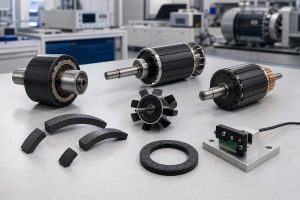
A related but often misunderstood category is hot pressed and hot deformed magnet technology, sometimes called die-upset magnets. In this approach, magnetic powders are consolidated under elevated temperature and pressure, followed by plastic deformation that induces grain alignment without the need for an external magnetic field. These magnets occupy a transitional position between traditional sintered magnets and bonded magnets: they offer high magnetic performance with improved mechanical strength and near-net-shape capability. Although less common, they are increasingly relevant in applications demanding both strength and structural robustness.
Bonded (Binder-Based) Magnet Forming Technologies
Bonded magnet technologies incorporate polymer or resin binders to form composite magnetic materials. Unlike fully dense magnets, bonded magnets sacrifice magnetic density in exchange for design freedom, mechanical durability, and manufacturing efficiency.
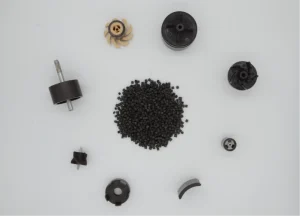
Injection molded magnet technology is the most widely used bonded forming method. Magnetic powder—typically NdFeB or ferrite—is blended with a thermoplastic binder and injected into molds with high dimensional precision. Field-assisted alignment can be applied during molding to create anisotropic bonded magnets, although magnetic performance remains lower than sintered counterparts due to binder dilution.
Injection molded magnets are frequently referred to as plastic-bonded magnets or polymer-bonded magnets. However, it is technically incorrect to label all molded magnets as injection molded; injection molding represents only one subset within bonded magnet technologies.
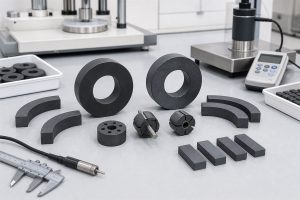
Compression molded magnets, also known as resin-bonded or pressed bonded magnets, use thermosetting resins and mechanical pressing to achieve higher magnetic particle loading than injection molding. These magnets provide a balance between magnetic performance and formability, with moderate shape complexity and improved magnetic output compared to injection molded magnets.
Extruded bonded magnets represent a more specialized bonded forming method, suitable for continuous profiles with uniform cross-sections. While geometry flexibility is limited, extrusion allows efficient production of long magnetic components with consistent properties.
Overlapping Technologies and Terminology Clarification
Certain forming approaches blur traditional boundaries. Field-aligned bonded magnets, for example, are produced using injection or compression molding but exhibit anisotropic behavior approaching low-grade sintered magnets. Similarly, over-molded magnetic components are often mistakenly classified as magnet forming technologies, whereas they are in fact assembly-level integration processes rather than primary forming methods.
Industry terminology is frequently inconsistent. Terms such as “molded magnets,” “bonded magnets,” and even “sintered magnets” are often used imprecisely, leading to confusion at the specification and procurement stages. From an engineering perspective, accurate identification of the forming route is essential to predict performance, cost, and reliability.
Engineering Significance of Forming Technology Selection
Magnet forming technology is not a secondary manufacturing detail; it is a core design decision that defines magnetic behavior, mechanical integrity, and system compatibility. Two magnets made from the same NdFeB powder but formed through different processes can exhibit drastically different magnetic strength, thermal stability, and service life.
Selecting the appropriate forming technology requires a system-level evaluation of magnetic requirements, geometric constraints, operating conditions, production volume, and downstream assembly strategy. Only by understanding forming technologies as part of a continuous chain—from magnetic materials to final application—can engineers design magnetic systems that are both performant and economically viable.
Related blog: Sintered vs. Injection Molded Magnets: A Technical Comparison