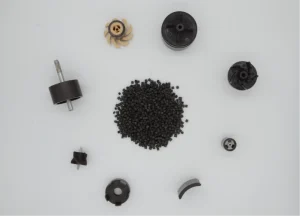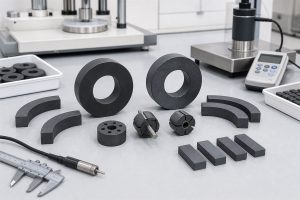


A hall effect magnetic sensor does not operate independently from its magnetic source. In real-world systems, the magnet defines the usable signal window, long-term stability, and repeatability of the entire sensing function.
Whether the system is designed as a discrete hall magnetic sensor or an integrated hall effect magnetic sensor module, the magnetic design ultimately determines performance limits far more than the electronics can compensate for.
This article focuses exclusively on the magnet-related engineering factors that govern Hall sensing quality — without touching IC selection, circuit design, or internal electronic principles.
1. Magnet Type: Matching Material Properties to Sensing Requirements
For any hall effect magnetic sensor, the magnet is not merely a trigger — it is the primary signal source. Different sensing tasks require different magnetic behaviors.
Common Magnet Types Used in Hall Magnetic Sensors
-
High magnetic energy density
-
Enable compact sensor modules
-
Suitable for miniaturized hall effect magnetic sensor modules with tight air gaps
Ferrite (ceramic) magnets
-
Lower magnetic output
-
Excellent thermal and environmental stability
-
Common in cost-sensitive hall magnetic sensor applications
Bonded magnets (NdFeB or ferrite)
-
Moderate magnetic strength
-
Excellent dimensional repeatability
-
Widely used in automotive-grade hall effect magnetic sensor modules
Engineering insight:
For Hall sensing, field consistency and predictability often matter more than peak magnetic strength.
2. Magnetic Field Distribution: What the Hall Sensor Actually “Sees”
A hall effect magnetic sensor responds only to the local magnetic flux density at its active area. Nominal magnet strength alone is meaningless without field-shape control.
Critical field characteristics include:
-
Field uniformity across the sensing zone
-
Gradient stability under air-gap variation
-
Sensitivity to angular or axial misalignment
Application Implications
-
Speed sensors rely on repeatable magnetic transitions
-
Angle sensors require smooth, sinusoidal field variation
-
ABS systems demand stable modulation over wide temperature ranges
Poor magnetic field distribution results in unstable output even when the hall magnetic sensor itself is electrically perfect.
3. Magnetization Method: Direct Impact on Signal Quality
In many hall effect magnetic sensor modules, signal distortion originates from magnetization errors rather than material limitations.
Common Magnetization Methods
Axial magnetization
-
Simple and robust
-
Used for proximity-based hall magnetic sensor designs
Diametrical magnetization
-
Strong directional field change
-
Common in rotary speed sensing
Multipole magnetization
-
Alternating north/south poles
-
Essential for angle sensing and high-resolution speed detection
Why This Matters
-
Pole pitch accuracy defines signal periodicity
-
Magnetization inconsistency creates output jitter
-
Electronics cannot correct magnetic non-uniformity
Key point:
For hall effect magnetic sensor modules, magnetization quality is often the limiting factor in accuracy.
4. Manufacturing Process: Consistency Over Peak Performance
In high-volume hall magnetic sensor applications, repeatability outweighs maximum magnetic output.
Process Influence on Magnet Consistency
Sintered magnets
-
Higher magnetic strength
-
More variation in small or complex shapes
Injection molded bonded magnets
-
Excellent dimensional and magnetic consistency
-
Ideal for integrated hall effect magnetic sensor modules
Compression molded bonded magnets
-
Higher powder loading
-
Stable multipole magnetization
-
Widely used in sensor rings and encoder magnets
Many perceived “sensor failures” are in fact magnet-to-magnet variation issues introduced during manufacturing.
Related blog: Sintered vs. Injection Molded Magnets: A Technical Comparison
5. Application-Specific Magnet Requirements
ABS Wheel Speed Sensors
-
Stable multipole fields
-
Resistance to thermal demagnetization
-
Long-term output consistency
Angle Position Sensors
-
Smooth rotational field symmetry
-
Tight control of magnetic harmonics
-
Alignment tolerance compatibility
Speed and Rotation Detection
-
Accurate pole spacing
-
Minimal harmonic distortion
-
Consistent field transitions across production lots
Each hall effect magnetic sensor module must be designed around its magnetic operating envelope, not just its electronic specifications.
6. Long-Term Stability: Ensuring Reliable Sensing Over Time
For hall magnetic sensors used in automotive and industrial environments, long-term magnetic stability is non-negotiable.
Key stability factors include:
-
Thermal aging resistance
-
Mechanical stress tolerance
-
Environmental corrosion protection
-
Demagnetization margin under abnormal conditions
A hall effect magnetic sensor that drifts magnetically over time cannot be corrected electronically.
Conclusion: Magnet Selection Defines Sensor Performance
Choosing a magnet for a hall effect magnetic sensor is not about maximizing strength.
It is about engineering a stable, repeatable magnetic field that supports accurate sensing under real operating conditions.
When magnet material, geometry, magnetization method, and manufacturing process are aligned, hall magnetic sensor systems achieve the reliability and precision they are designed for.
Read more: How to Choose and Maintain Fan Motors for Refrigerators, Air Conditioners, and HVAC Systems