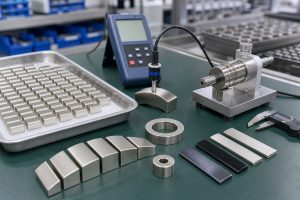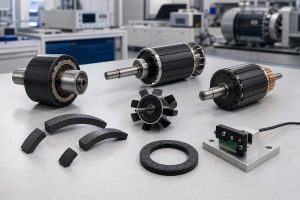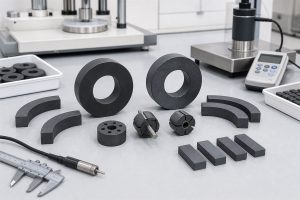


Every motor, sensor, and magnetic assembly has different demands. And if you’ve ever tried to fit a stock magnet into a product that wasn’t designed around it, you know the frustration. The tolerances don’t hold up, the flux density falls short, or the shape just won’t work inside your housing.
That’s where custom magnets come in. At Chase Technology, we’ve spent over a decade helping engineers match the right magnet type to the right application. The difference is bigger than most people expect. We also deliver custom finished magnetic components based on your design requirements to fit your exact assembly needs. Here’s a practical breakdown of how different industries use custom magnetic solutions, and what you should know before placing your next order.
How Custom Magnets Serve Different Industries
Not all applications need the same magnet. Sounds obvious, right? But we still see teams ordering the same NdFeB grade for a sensor that they’d use in a drive motor. The result? Over-engineered parts, wasted budget, or even underperformance in the field. Therefore, choosing the right magnet requires considering both the specific application scenario and its performance requirements. It’s best to define the performance requirements first, then select the appropriate magnet type based on how it will be used.
Here’s how this plays out across different industries.
Automotive
Demand for electric motors is surging across EVs, e-mobility, drones, and industrial automation. It is one of the strongest growth drivers for the magnet industry. Compact, efficient motors often rely on rare-earth permanent magnets (especially NdFeB) to deliver high torque and power density.
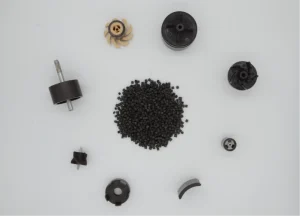
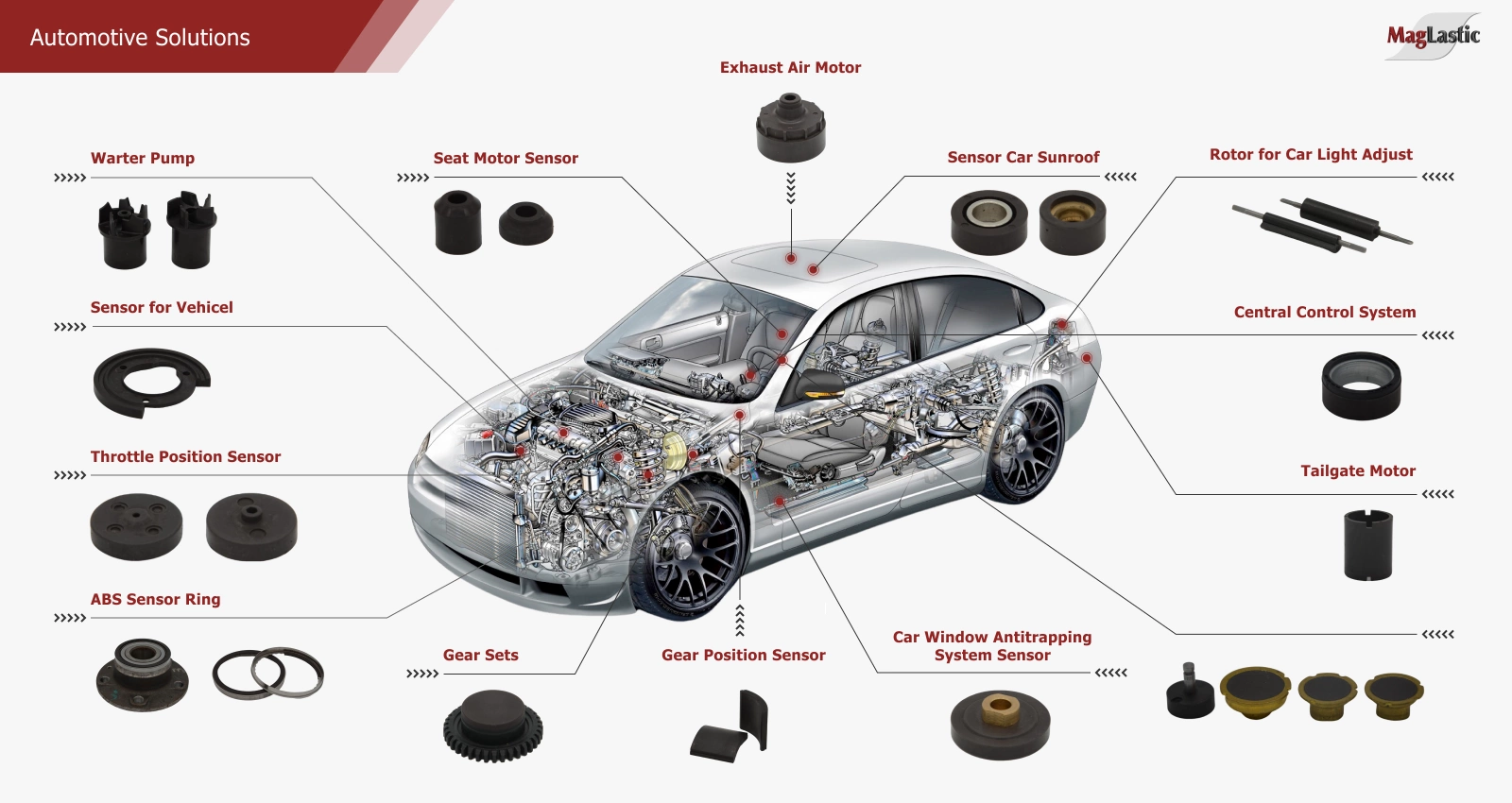
- For automotive applications, injection-molded magnets are our go-to for sensors, water pumps, micro motors, EXV (electronic expansion valve) rotors, and other compact electromechanical components. They support multipole magnetization, tight tolerances, and the kind of volume repeatability carmakers demand. Materials like injection-molded ferrite and SmFeN handle the temperature swings inside engine bays and EV drive units without degrading.
- Beyond sensors and small components, injection-molded NdFeB is also widely used in high-volume automotive applications such as auxiliary motors, actuators, and hybrid system components, where cost efficiency, net-shape forming, and design integration are key priorities. Explore our full custom magnet and rare earth product range to see what’s available across all three manufacturing methods.
Industrial Automation and Robotics
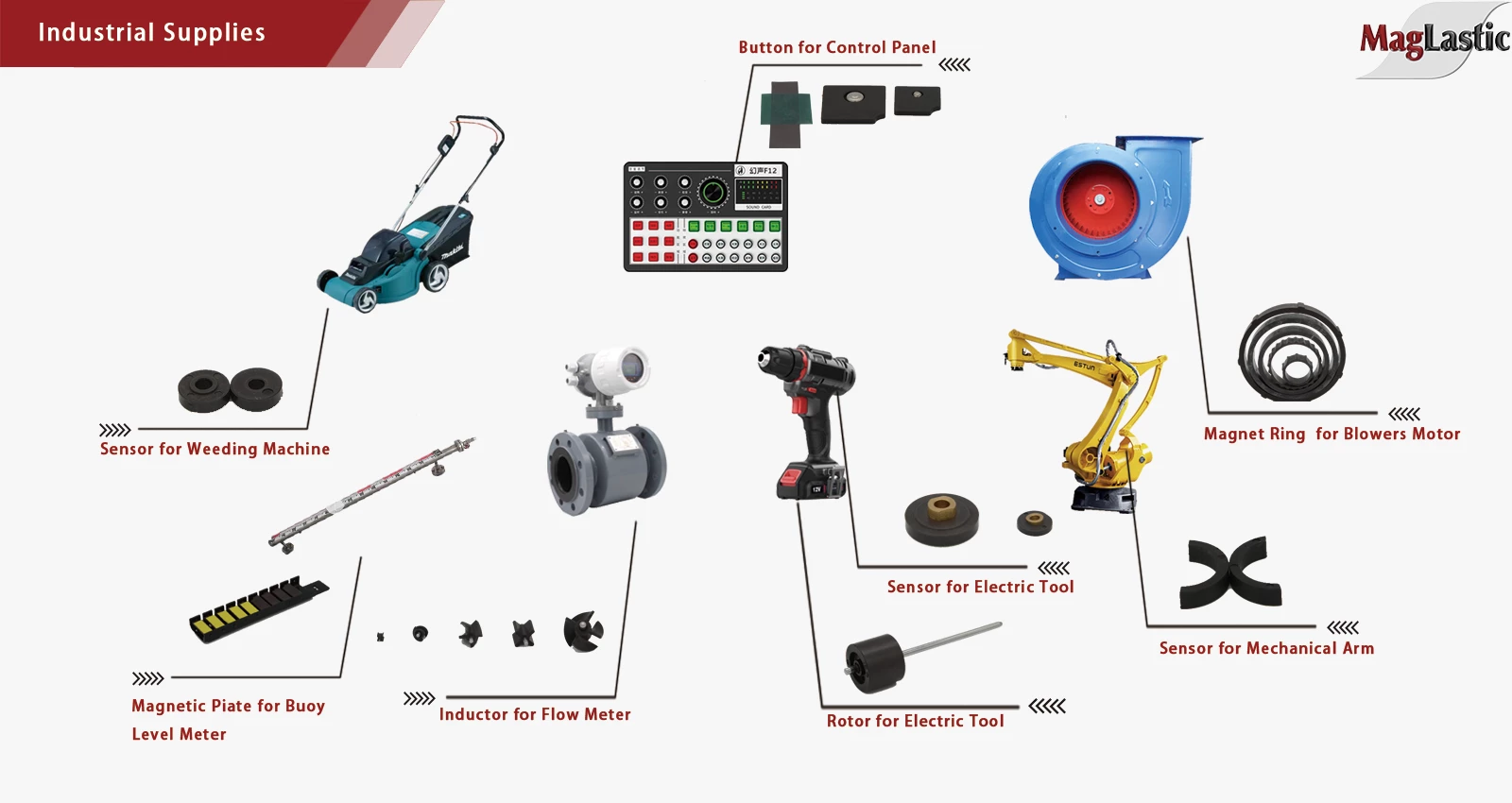
Robotics and automation are driving strong demand for compact, high-precision magnetic components, particularly in systems such as encoders, magnetic sensors, and micro-motors. These components require stable magnetic performance and high consistency over millions of operating cycles.
For these applications, injection-molded magnets are widely used due to their ability to achieve multipole magnetization, tight dimensional control, and high repeatability in mass production. They are especially well-suited for integrated sensor modules and compact motor assemblies where space and precision are critical. In some cases where higher magnetic density is required in simpler geometries, compression-bonded magnets may also be used. However, in robotic sensing and micro-motion systems, design flexibility and signal stability are typically more important than raw magnetic strength, making injection-molded solutions a better fit.
Home Appliances
Brushless DC motors power everything from washing machines to air conditioners. Energy efficiency standards keep tightening, especially in Europe, so the magnetic circuit in these motors matters more than ever.
We’ve seen strong results using injection-molded magnets in BLDC rotor assemblies. The net-shape molding process eliminates secondary machining, which keeps per-part costs down at high volumes. And for simpler applications, such as door latches or magnetic switches, injection-molded ferrite is often enough. It delivers the required performance at a much lower cost.

Consumer Electronics and Emerging Tech
As consumer devices become smaller and more powerful, the demand for compact, high-performance magnets grows. Innovations in micro-magnetic materials are enabling further miniaturization of components for smartphones, wearables, and medical devices.
Here, injection–molded magnets shine due to their geometric freedom. You can mold them directly onto shafts, housings, or inserts. This creates a single integrated part. It reduces assembly steps and improves dimensional consistency.

Quick Comparison: Which Magnet Type for Which Application?
| Application | Suitable Magnet Type | Why |
| EV traction motors | Sintered NdFeB | Maximum magnetic strength |
| Automotive sensors | Injection molded (ferrite/SmFeN) | Multipole, tight tolerance, high volume |
| BLDC motors (appliances) | Injection molded NdFeB | Net-shape, no machining, cost-effective |
| Servo systems, robotics (encoders, sensors, micro-motors) | Injection-molded magnets | High repeatability, signal stability, compact integration |
| Miniature electronics | Injection molded NdFeB | Complex shapes, overmolding capability |
| Wind turbine generators | Sintered NdFeB | High energy product, thermal stability |
It’s important to note that each industry or application is not limited to a single magnet type. The final selection should always be based on specific performance requirements to identify the most suitable magnetic solution.
What to Look for in a Custom Magnet Supplier
Honestly, the magnet itself is only part of the equation. The supplier’s engineering support matters just as much. Here’s what we think separates a good partner from a parts vendor:
- Simulation capability: Can they run FEM analysis to validate your magnetic circuit before cutting steel? We do this routinely at Chase Technology, and it catches design issues early.
- In-house tooling: If the supplier outsources mold making, your lead time doubles. We build our own tools.
- Surface treatment options: NdFeB magnets corrode without proper coating. Make sure your supplier offers nickel, epoxy, or application-specific coatings.
- Quality traceability: Especially for automotive-grade parts, you need full lot traceability and consistent inspection protocols.
So what should you do? Work with a supplier that has vertical control. Contact us with your design requirements, and we can develop fully customized magnet assemblies tailored to your project.
Key Takeaways
- Match the magnet to the application, not the other way around. Automotive sensors, EV motors, and consumer devices all need different solutions.
- Injection-molded magnets offer the most geometric freedom and scale well. Compression-bonded delivers stronger output per volume. Sintered is still king for raw magnetic power.
- Supplier capabilities (simulation, tooling, surface treatment, quality control) matter as much as the magnet spec itself.
- Don’t over-specify. A magnet that is good enough for the application is often the better choice. It balances cost and volume. A technically superior magnet is not worth it if it blows your budget.
FAQs
What is the typical MOQ for custom magnets?
MOQ depends on the manufacturing method and tooling requirements. Injection-molded and compression-bonded custom magnets usually require higher volumes due to mold costs, while some simpler magnet types may allow lower MOQs. For most projects, suppliers will evaluate your design, volume, and application before confirming MOQ and pricing.
Can one magnet type work across multiple applications?
Sometimes. But it is rarely ideal. Injection-molded NdFeB is one of the most versatile options. It works well in sensors, small motors, and consumer electronics. But for high-torque motors or extreme temperatures, you’ll likely need sintered NdFeB or SmCo. The best approach is to define your performance envelope first, then pick the manufacturing method.
How do I decide between injection–molded and compression–bonded magnets?
It comes down to shape complexity vs. magnetic strength. If you need intricate geometries, overmolding, or multipole magnetization, injection molding wins. If you need stronger magnetic output in simpler shapes like rings and arcs, go with compression bonding. We can run simulations to help you compare before committing to tooling.
Are rare earth magnets getting more expensive?
The cost of rare earth elements can fluctuate dramatically due to shifts in demand, production caps, or market speculation. Tariffs exacerbate this volatility by introducing additional financial burdens. Working with a manufacturer that controls compound formulation in-house helps buffer some of that pricing pressure.
Can custom magnets be made in complex shapes and sizes?
Yes, one of the biggest advantages of custom magnetic products is design flexibility. Manufacturing methods like injection molding allow magnets to be formed into complex geometries or even integrated directly into plastic components. This makes them ideal for compact assemblies, tight tolerances, and products that require precise magnetic positioning.