

BLDC motor performance depends on the rotor magnet architecture as much as the stator, winding, controller, or bearing design. In many small motors, pump rotors, fans, actuators, and compact drive systems, the key question is not simply “Which magnet is stronger?” It is “Which rotor magnetic assembly gives the required torque, speed, balance, manufacturability, and long-term reliability?”
Two common choices are injection-molded bonded ring magnets and sintered arc magnets. Both can be used in BLDC motors, but they solve different engineering problems. An injection-molded bonded magnetic ring can simplify assembly and support integrated molded geometry. Sintered arc magnets can deliver higher magnetic energy density, but usually require more careful segmentation, bonding, retention, and balance control.
This guide compares injection-molded bonded ring magnets and sintered arc magnets from the viewpoint of custom motor rotor magnetic assemblies, especially for micro motors, water pump rotors, permanent magnet rotors, and high-volume BLDC applications.
What Are Motor Rotor Magnets in a BLDC Motor?
In a brushless DC motor, the rotor carries permanent magnets and rotates inside or around the stator magnetic field. These rotor magnets provide the magnetic field that interacts with the stator windings to generate torque.
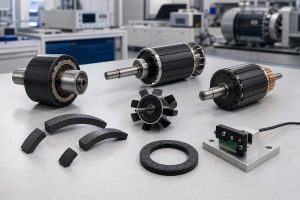
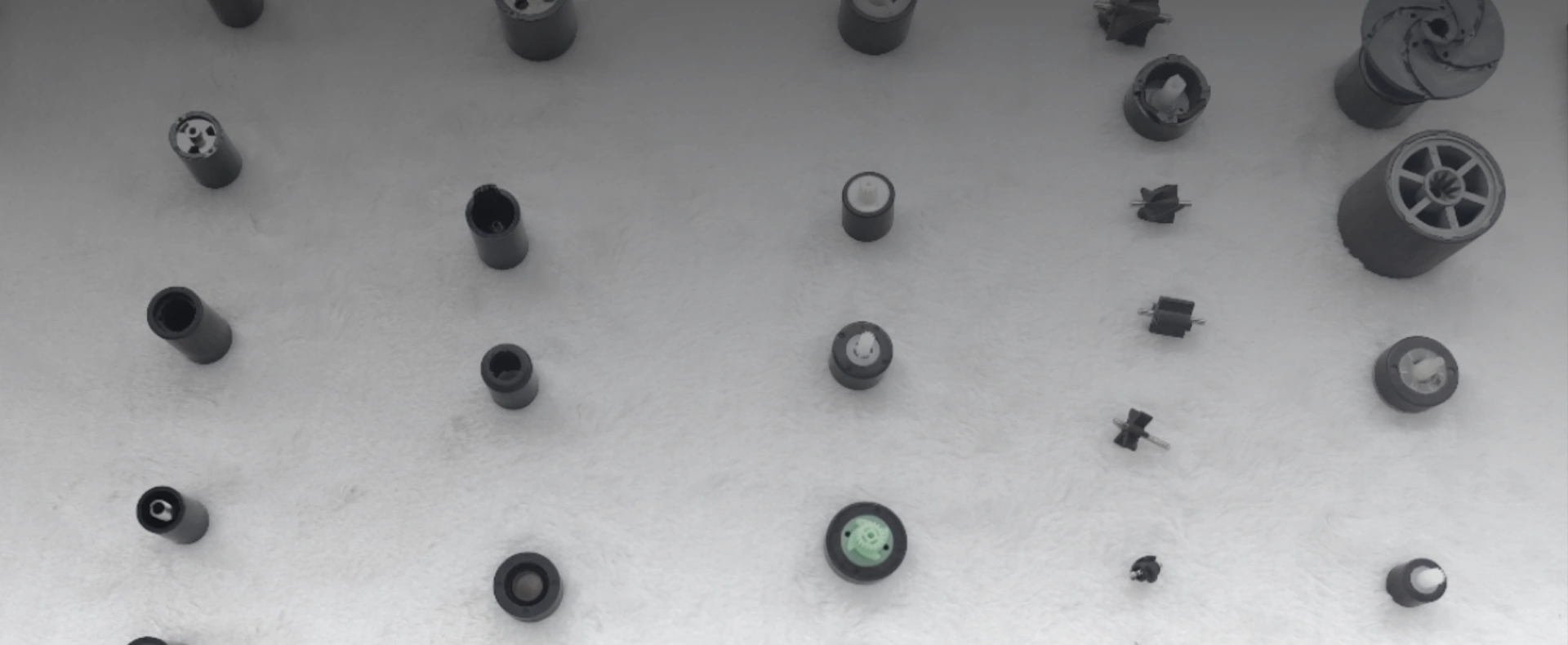
For small BLDC motors, the magnet is often not a loose commodity part. It may be molded around a shaft, assembled into a rotor hub, combined with a pump impeller, or designed as a compact permanent magnet rotor. This is why Chase Technology treats many rotor programs as custom magnetic assembly projects rather than simple magnet supply.
Related Chase products and capabilities include motor rotor components, cooling water pump rotors, injection molded magnets, compression molded magnets, and sintered magnets.
Injection-Molded Bonded Ring Magnets: Integrated Rotor Geometry
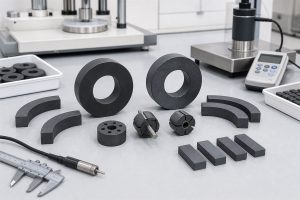
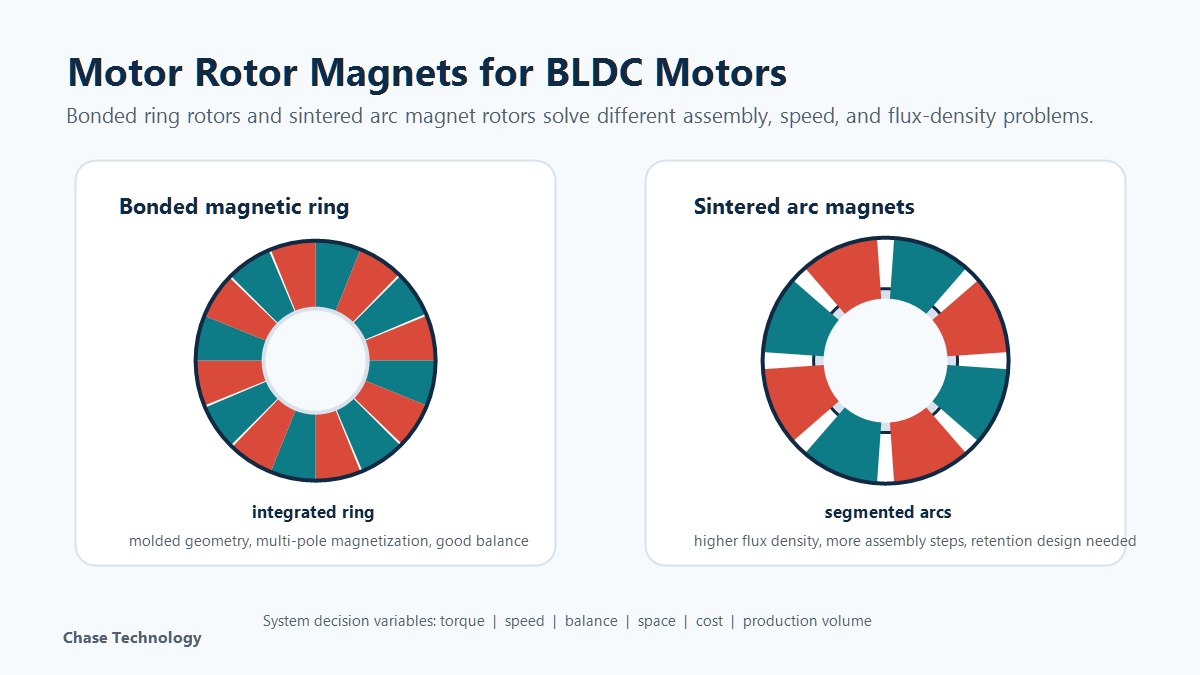
A bonded ring magnet is made by mixing magnetic powder with a polymer binder and forming the material into a ring or rotor shape. Depending on the process, the ring can be injection molded or compression molded. Magnetic powders may include ferrite, NdFeB, SmFeN, or other application-specific compounds.
For BLDC rotors, the main advantage is integration. Instead of placing several arc magnets one by one, the magnetic function can be built into a single ring or molded rotor component. The part can also be designed around a hub, shaft, sleeve, or plastic structure.
Where Injection-Molded Bonded Ring Magnets Fit Best
- Micro motors where small size and consistent assembly matter
- Water pump rotors and impeller-integrated magnetic assemblies
- High-volume appliance motors, fan motors, and compact drive systems
- Rotors requiring multi-pole magnetization in one molded part
- Applications where reduced assembly steps are more valuable than maximum flux density
Injection molded bonded magnets are especially useful when the rotor has a complex shape, needs insert molding, or must combine magnetic performance with mechanical structure.
Sintered Arc Magnets: High Magnetic Energy Density
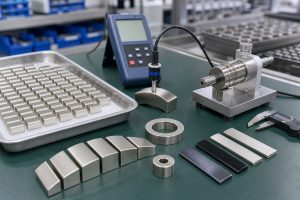
Sintered arc magnets are usually individual curved magnet segments bonded or retained around a rotor core. Sintered NdFeB is common when the motor requires very high magnetic energy density in a compact space.
The advantage is magnetic strength. For the same volume, sintered NdFeB can provide higher remanence and energy product than most bonded magnet materials. This can support higher torque density, smaller motor size, or improved performance in demanding motor designs.
The tradeoff is assembly complexity. Arc magnets must be accurately positioned, bonded, retained, and sometimes protected against corrosion or mechanical stress. For high-speed rotors, magnet retention and crack risk become major design issues.
Where Sintered Arc Magnets Fit Best
- High-torque BLDC motors with limited magnet volume
- Motors where maximum flux density is the primary design constraint
- Rotor designs that can tolerate segmented magnet assembly
- Applications with enough space for adhesive, sleeve, or mechanical retention
- Programs where performance justifies higher assembly and inspection cost
Rotor Magnets Should Be Designed as Assemblies
For BLDC motors, the rotor magnet cannot be evaluated only by magnetic grade. The finished rotor must meet magnetic, mechanical, thermal, and production requirements together.
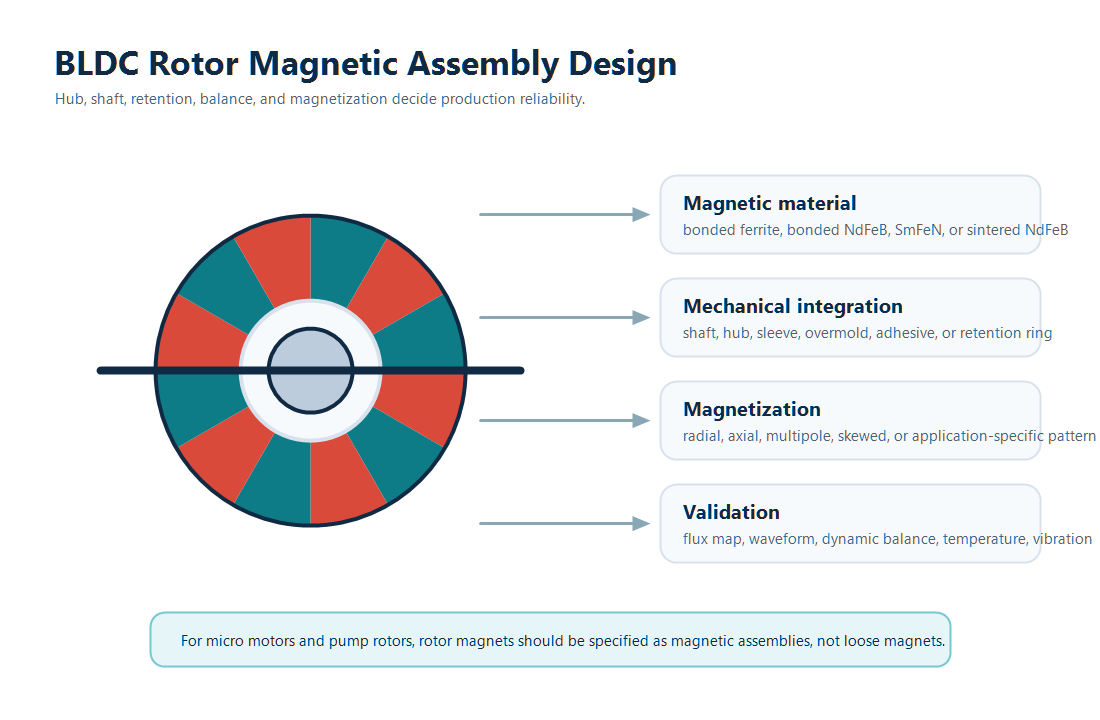
A good rotor magnetic assembly design should consider:
- Magnetic material: injection-molded ferrite, injection-molded NdFeB, SmFeN, sintered NdFeB, or another material system
- Rotor geometry: ring, sleeve, hub, arc segment, impeller-integrated rotor, or custom molded shape
- Magnetization: radial, axial, multi-pole, skewed, or application-specific pole pattern
- Retention: adhesive, sleeve, overmolding, insert molding, interference fit, or mechanical lock
- Balance: concentricity, runout, mass distribution, and high-speed vibration behavior
- Validation: flux map, waveform, dynamic balance, temperature cycling, and vibration testing
When the rotor is used in a pump, fan, or micro motor, the magnet may also interact with the shaft, impeller, fluid exposure, and sealing structure. That makes early magnetic assembly design more important than late-stage magnet substitution.
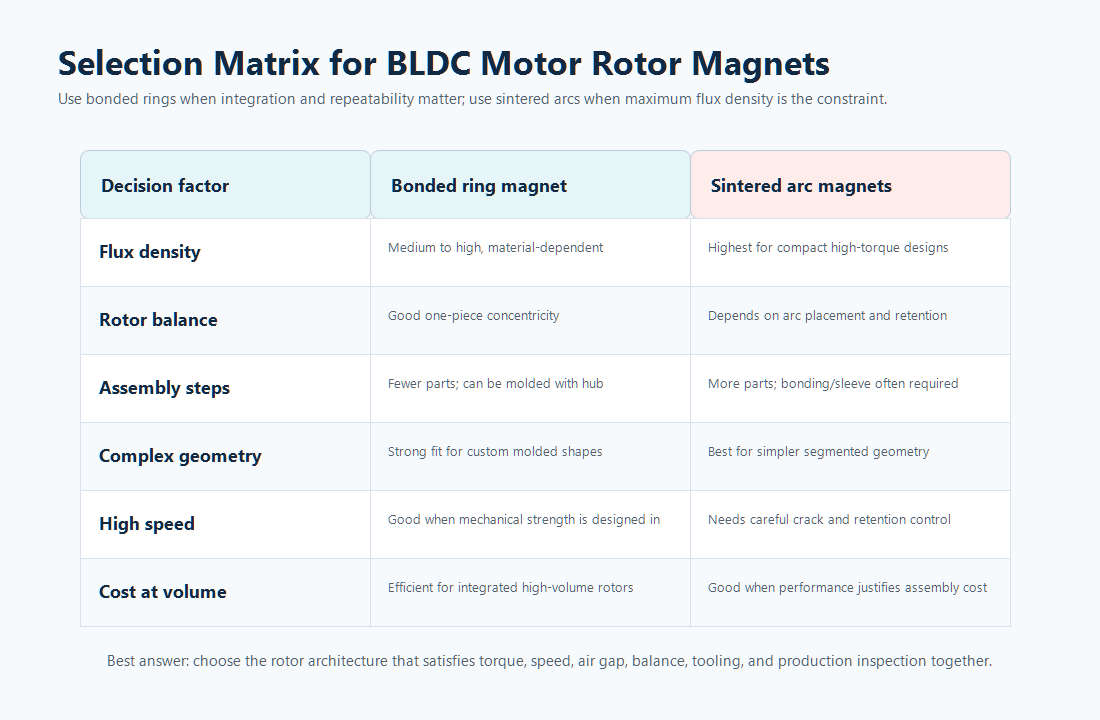
Injection-Molded Bonded Rings vs Sintered Arc Magnets: Key Differences
| Decision Factor | Injection-Molded Bonded Ring Magnet | Sintered Arc Magnets |
|---|---|---|
| Magnetic strength | Medium to high depending on powder, binder, and process | Usually higher, especially with sintered NdFeB |
| Rotor integration | Excellent for molded rings, hubs, inserts, and complex shapes | Usually assembled as separate curved segments |
| Assembly steps | Fewer parts; can reduce bonding and positioning steps | Requires accurate placement, bonding, and retention design |
| Rotor balance | Good potential because the ring can be one-piece and concentric | Depends on arc placement, adhesive consistency, sleeve design, and inspection |
| High-speed reliability | Good when material strength, molding, and rotor design are matched | Requires careful crack prevention and mechanical retention |
| Corrosion resistance | Often good for ferrite or protected bonded compounds | Sintered NdFeB usually needs coating and environmental protection |
| Tooling and volume | Strong for high-volume custom rotor components after tooling is confirmed | Flexible for performance-driven designs, but assembly cost can rise |
Torque Density: When Sintered Arc Magnets Have the Edge
If the motor design is limited by available magnet volume and requires maximum air-gap flux, sintered arc magnets may be the better option. Sintered NdFeB can provide very high magnetic energy density, which helps compact motors reach higher torque in a smaller package.
However, torque density is not the only design target. If the rotor requires complex geometry, fluid exposure, high production volume, or integrated plastic structures, injection-molded bonded ring magnets may deliver a more practical system-level solution even when their magnetic energy density is lower.
Rotor Balance and High-Speed Performance
High-speed BLDC rotors are sensitive to mass distribution and magnet retention. Small differences in arc magnet placement, adhesive thickness, or sleeve concentricity can affect dynamic balance. At high rotational speed, that can turn into vibration, noise, bearing stress, or rotor failure risk.
An injection-molded bonded ring magnet can reduce these risks by forming the magnetic section as one integrated ring. This does not automatically guarantee good balance, but it gives the rotor design a cleaner starting point because the magnetic material is distributed continuously around the axis.
Sintered arc magnets can also work in high-speed rotors, but they require strong retention design, crack prevention, adhesive control, and inspection. This is why Chase’s existing discussion of high-speed motor magnetic materials is closely related to rotor architecture, not just material grade.
Micro Motors and Pump Rotors: Why Injection-Molded Bonded Rings Are Often Practical
In micro motors and pump rotors, a compact rotor often needs magnetic function and mechanical function in the same part. A pump rotor may need a magnetic ring, shaft interface, impeller structure, fluid resistance, and stable balance. A small fan motor may need quiet rotation, consistent pole pattern, and low assembly cost.
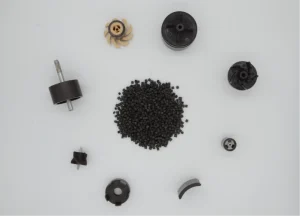
Bonded ring magnets, especially injection molded magnets, can support these requirements because they allow the magnet to be shaped around the product design. The rotor may be molded as a ring, overmolded onto a metal insert, or combined with other functional structures.
This is particularly relevant for applications such as water pumps, home appliance motors, compact BLDC fans, and small actuator motors where production repeatability matters as much as peak magnetic strength.
When to Choose an Injection-Molded Bonded Ring Magnet
Choose an injection-molded bonded ring magnet when the rotor design needs integration, repeatability, or complex geometry.
- The rotor is small and assembly space is limited
- The magnet needs multi-pole magnetization in a single ring
- The part must be molded around a shaft, hub, sleeve, or carrier
- The application values rotor balance and dimensional consistency
- The motor is used in a pump, fan, actuator, or appliance with high-volume production
- The project needs fewer assembly steps than segmented arc magnet bonding
Injection-molded ferrite, injection-molded NdFeB, and SmFeN compounds can each be considered depending on magnetic output, temperature, corrosion resistance, and mechanical requirements.
When to Choose Sintered Arc Magnets
Choose sintered arc magnets when the motor needs the highest magnetic energy density and the rotor design can support segmented magnet assembly.
- The motor requires very high torque density
- Available magnet volume is extremely limited
- The rotor can accept bonding, sleeves, or mechanical retention
- The application justifies stricter arc placement and balance inspection
- Coating and corrosion protection can be properly managed
- The rotor geometry is compatible with separate arc magnet segments
Sintered arcs can be the right choice for high-performance motors, but the full rotor assembly cost and risk should be evaluated early.
Conclusion
Injection-molded bonded ring magnets and sintered arc magnets both have a place in BLDC motor rotor design. Sintered arc magnets are strong candidates when the motor needs maximum magnetic energy density. Injection-molded bonded ring magnets are often better when the rotor needs integrated geometry, multi-pole magnetization, fewer assembly steps, good concentricity, and high-volume production repeatability.
For micro motors, water pump rotors, permanent magnet sensors, and permanent magnet rotor assemblies, the best answer is rarely a material name alone. It is a complete magnetic assembly design that balances torque, speed, air gap, retention, balance, tooling, and inspection.
FAQ
Are injection-molded bonded ring magnets good for BLDC motors?
Yes. Injection-molded bonded ring magnets are a good fit for many BLDC motors, especially small motors, pump rotors, fan motors, and high-volume custom rotor assemblies that need integrated geometry, multi-pole magnetization, and consistent balance.
When should I use sintered arc magnets in a motor rotor?
Sintered arc magnets are usually preferred when the motor needs very high torque density or maximum magnetic flux in limited space. They require careful assembly, retention, coating, and balance control.
Which is stronger, an injection-molded bonded ring magnet or a sintered arc magnet?
Sintered NdFeB arc magnets usually provide higher magnetic energy density than injection-molded bonded ring magnets. However, the best rotor design also depends on assembly complexity, speed, balance, environment, and production cost.
Can injection molded magnets be used in pump rotors?
Yes. Injection molded magnets are often used in pump rotors because they can combine magnetic function with molded rotor geometry, insert molding, fluid-resistant material choices, and stable production repeatability.