

A gear position sensor is one of those parts you never think about until it fails. Then your transmission will not shift, your car may not start, and the check engine light can turn on. A faulty gear position sensor can lead to difficulties in transmission shifting or even render the car unable to start. For engineers and procurement teams designing or sourcing these sensors, the magnet inside is where signal quality starts. And it’s where most problems start, too.
We build injection-molded magnets for gear position sensors every day, so we’ve seen firsthand what separates a magnet that works from one that works well. Let’s break it down.
What Does a Gear Position Sensor Actually Do?
The gear position sensor detects the position of the gear, such as first or second, and sends the data as an electric signal to the ECU. That signal tells the vehicle’s computer what gear you’re in so it can manage engine timing, fuel injection, and shift logic. Most modern designs are non-contact, meaning no mechanical wear points.

How Hall Effect Magnets Make Gear Detection Work
Hall elements are used as the magnetic sensor. When an external magnetic field is applied to the electrified semiconductor, the Lorentz force generates an electric potential difference called the “Hall voltage,” and that voltage maps directly to the magnetic field strength.
So the sensor reads voltage. The magnet creates the field. Since magnetic field strength and Hall voltage share a linear relationship, the Hall element’s accuracy in rotary angle detection depends directly on how clean and consistent that magnetic field is.
That’s the part most people miss. If the magnetic field drifts, weakens, or becomes uneven, the voltage output drifts too. The ECU gets a noisy signal and makes bad decisions.
Related article: What Factors Should I Consider When Selecting a Magnet for My Hall Effect Sensor?
Three Ways Magnet Quality Makes or Breaks Accuracy
1. Magnetic Field Uniformity
Weak or non-uniform magnetic fields account for roughly 70% of positioning errors. That’s a big number. If the magnet doesn’t produce a consistent field across its face, the Hall sensor picks up different readings depending on angle, even when the gear position hasn’t changed.
This is where material choice matters. A poorly mixed magnetic compound or inconsistent powder density creates hot spots and dead zones in the field. Many sensor applications don’t need the highest possible magnetic strength. They need a precisely shaped and located magnetic field, which is often more critical for accuracy than raw power.
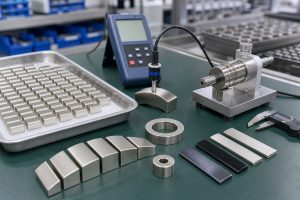
Our injection molded magnets are designed with this in mind. The injection molding process gives us control over particle distribution in the compound, which translates directly to uniform surface gauss across the magnet.
2. Dimensional Tolerance
This one’s sneaky. When a gear position sensor is installed across different vehicles, inevitable variations in the air gap distance between the Hall device and the magnet cause different signal switching angles. This makes it difficult to guarantee consistent neutral and in-gear detection across units.
In plain terms: if your magnet is 0.3mm thicker or thinner than spec, the air gap changes. The field strength at the sensor changes. And your switching thresholds shift.
The high-precision injection molding process ensures that every magnet in a high-volume production run has identical dimensions and magnetic properties, which is critical for sensor reliability.
3. Thermal Stability
Transmissions get hot. Really hot. Standard magnets lose 0.1–0.2% of their field strength per degree Celsius, causing positioning drift. Over a 100°C temperature swing, that’s a 10–20% signal change. Enough to push a sensor reading across a switching threshold and trigger a false gear detection.
We build our automotive magnet solutions with PPS and PA12 binder systems specifically chosen for thermal resilience. Our bonded magnetic compounds operate within a temperature range of -40°C to 150°C without cracking or significant demagnetization.
Why Injection-Molded Magnets Are the Better Choice
Not all magnets are created equal when it comes to sensor applications. Sintered magnets are strong, but while sintered magnets are stronger, many sensor applications do not require the highest possible magnetic strength. Instead, they require a precisely shaped and located magnetic field. Injection-molded magnets excel at providing this tailored field.
And there’s more to it than just field shape:
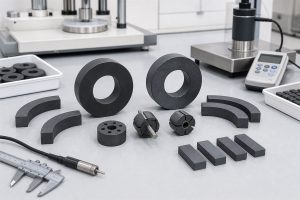
- Tight tolerances: The injection molding process allows for complex geometries that can focus magnetic flux, create multi-pole configurations, and incorporate features like holes or gears, simplifying assembly.
- Repeatability at scale: The automated injection molding process allows for rapid cycle times and the production of millions of identical parts with minimal labor, dramatically lowering the per-part cost at scale.
- Durability: The main benefits include unmatched design freedom to create complex shapes, exceptional repeatability for reliability in high-volume production, and superior durability due to the polymer binder that resists corrosion and impact.
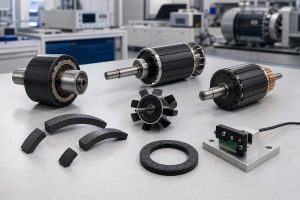
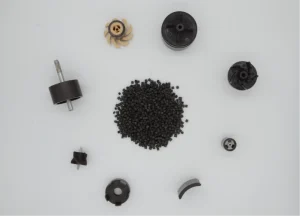
Injection molded magnets can be manufactured in virtually any shape imaginable, allowing engineers to design a magnet that fits the application perfectly rather than designing around a standard shape. They can also be over-molded onto shafts, gears, or other carriers, consolidating parts.
For gear position sensors, this allows the magnet to be molded directly into the sensor assembly, resulting in fewer parts, tighter tolerances, and better repeatability.
Related article: Sintered vs. Injection Molded Magnets: A Technical Comparison
Conclusion
The gear position sensor is only as good as the magnet inside it. Magnetic field uniformity, tight dimensional control, and thermal stability are not “nice to haves.” They are the difference between a sensor that reads correctly and one that triggers fault codes at 80,000 miles.
If you’re developing or re-sourcing sensor magnets for automotive transmissions, we’d be glad to run a magnetic simulation for your specific design. Get in touch with our team and let’s talk specifics.
FAQs
What does a gear position sensor do in a car?
A gear position sensor detects which gear is currently selected in the transmission and sends that data as an electrical signal to the ECU. This information controls shift logic, starter interlock (preventing start unless in Park or Neutral), and reverse light activation.
Why do injection molded magnets work well for gear position sensors?
Injection molded magnets offer superior design flexibility, tighter dimensional tolerances, and greater cost-effectiveness at scale compared to sintered magnets. For sensors, their ability to produce uniform magnetic fields in complex shapes makes them a strong fit, especially when you need consistent output across millions of parts.
Can Chase Technology supply custom sensor magnets for automotive programs?
Yes. We offer custom magnetic assemblies. Our team supports Tier 1 and OEM customers with injection molded, compression bonded, and sintered magnet solutions.