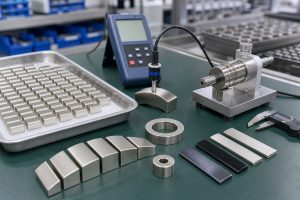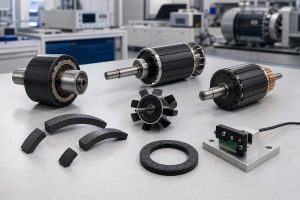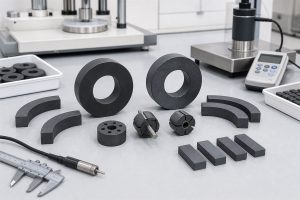


Wondering if injection-molded magnets work for ABS sensor rings? Yes, they are actually ideal for automotive production. You can easily mold polymer-bonded ferrite into precise custom shapes, often with metal inserts built right in.
But getting great factory results takes more than just hitting the start button. You have to plan the pole pattern, concentricity, air gap, and test methods together to ensure consistent sensor performance on the road.
What Is an ABS Sensor Ring?
An active ABS sensor ring is a magnetic encoder fixed to the rotating wheel hub or bearing. Alternating north and south poles pass the stationary Hall or magnetoresistive sensor, creating a changing field. The sensor electronics convert that change into pulses used to calculate wheel speed.
The ring is the rotating target, not the electronic sensor. Signal quality depends on both parts and their controlled relative position. For a basic system overview, see how an ABS magnetic ring works.

Selecting the Right Material for an ABS Sensor Ring
Bonded Ferrite With PA6 or PA12
Bonded ferrite balances cost, corrosion resistance, magnetic stability, and moldability. PA6 can provide strength and processability, while PA12 can support lower moisture uptake depending on formulation. Select the grade from measured requirements, not binder name alone.
Chase Technology’s injection molded magnet data lists ferrite compounds with PA6, PA12, and PPS systems across different magnetic and mechanical property ranges.
Bonded NdFeB for Higher Output
Bonded NdFeB can provide more magnetic output in limited space, but it raises material cost and may require additional corrosion and temperature review. It is not automatically the better ABS sensor ring material. If bonded ferrite already meets the waveform and sensing-distance requirements, its cost and environmental behavior can make it the more practical choice.
Critical ABS Sensor Ring Design Requirements
Pole Count, Pitch, and Waveform
The customer must define the number of north-south pole pairs, pole pitch, magnetic track position, sensing direction, and allowable waveform variation. More poles can improve angular resolution, but the sensor must still distinguish transitions at the specified air gap and speed. Pole-to-pole amplitude, transition position, missing poles, and harmonic distortion are more informative than one peak surface-gauss value.
Axial or Radial Magnetization
An axial track is read from the face of the ring. A radial track is read from the outside or inside diameter. The sensor location and bearing layout determine the correct direction. The magnetizing fixture, part datum, and inspection fixture must all use the same angular and axial references.
Air Gap, Runout, and Concentricity
Magnetic field decreases with distance, so the production air-gap window must include bearing tolerance, ring runout, sensor mounting error, thermal expansion, and wear. Radial or axial runout can modulate the signal even when the pole pattern is correct. Specify the measurement radius and height, then correlate component inspection with the assembled sensor output.
Why Injection Molding Fits ABS Sensor Rings
Near-Net Ring Geometry
Injection molding can form a thin magnetic track, locating ribs, sealing features, and carrier interfaces in one repeatable cycle. Compared with machining a brittle sintered ring, the process can reduce secondary operations and support higher-volume production. The mold still needs suitable gate position, flow balance, draft, shrinkage allowance, and control of weld lines near critical features.
Metal Insert Integration
A prepared steel ring can be loaded into the mold so the magnetic compound forms around it. The insert provides mechanical location and hub compatibility, while the molded track supplies the encoder signal. Surface condition, undercuts, insert temperature, concentric location, and molding pressure affect retention. Pull-off or torque testing should verify the joint rather than relying on visual inspection.
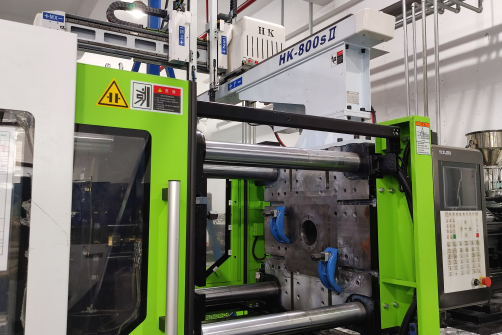
How Injection Molding Creates the ABS Ring
Molding and Insert Control
A typical process includes compound verification and drying, metal-insert preparation, automated or controlled loading, injection molding, cooling, de-gating, dimensional inspection, and cleaning. Process controls may cover moisture, melt temperature, mold temperature, injection pressure, hold pressure, cycle time, insert position, and cavity identification. Traceability should connect each finished lot with the compound, insert batch, mold, machine, and process record.
Multipole Magnetization and Inspection
The molded ring is magnetized in a dedicated fixture that establishes the pole count, pitch, direction, and angular index. Chase Technology’s magnetizing-fixture capability supports application-specific axial and radial patterns. A waveform scanner then measures the complete track along the agreed sensor path. Fixture wear and part seating must be controlled because they can shift the waveform.
How to Validate an ABS Sensor Ring
Magnetic and Dimensional Validation
Validate pole count, pole position, amplitude, waveform uniformity, magnetic track width, runout, concentricity, flatness, carrier dimensions, and insert retention. Measurement-system analysis is needed for critical checks. The final proof is sensor output over the required air gap, speed, temperature, and mounting tolerance, not a material certificate by itself.
Automotive Environmental Validation
The validation plan may include thermal cycling, humidity, salt spray, fluids, vibration, mechanical shock, debris impact, and rotational durability. Conditions must come from the vehicle or bearing specification. Recheck waveform and mechanical retention after testing; Chase Technology lists relevant magnetic and durability test capabilities.
Get a Custom ABS Sensor Ring Quote
Chase Technology can review bonded ferrite or bonded NdFeB material, insert design, multipole magnetization, tooling, waveform inspection, and validation for a custom ABS sensor ring. If you have a project in mind, contact us to discuss your requirements.
FAQs
Can ABS Sensor Rings Be Injection Molded?
Yes. Bonded magnetic compound can be injection molded into a ring or around a metal carrier, then multipole magnetized for active wheel-speed sensing.
What Material Is Used in ABS Rings?
Common magnetic encoders use ferrite with rubber or a thermoplastic binder. Injection molded options often use ferrite with PA6 or PA12; bonded NdFeB is possible when higher output is justified.
How Is an ABS Ring Magnetized?
A dedicated fixture creates alternating north and south poles around the ring. The pattern may be axial or radial depending on where the wheel-speed sensor reads the track.
What Air Gap Does an ABS Sensor Need?
There is no universal value. The sensor specification, magnetic material, pole pitch, waveform, bearing tolerances, runout, and temperature determine the allowable minimum and maximum air gap.
How Are ABS Sensor Rings Tested?
Testing commonly covers full-track magnetic waveform, pole position, dimensions, runout, insert retention, and sensor output. Automotive programs may add temperature, humidity, salt, vibration, impact, and rotational durability.
Request an Injection Molded ABS Sensor Ring Review
Chase Technology can review bonded ferrite or bonded NdFeB material, insert design, multipole magnetization, tooling, waveform inspection, and validation for a custom ABS sensor ring. Send the ring drawing, sensor data, pole pattern, air-gap window, operating conditions, and annual volume through our magnet engineering contact page.