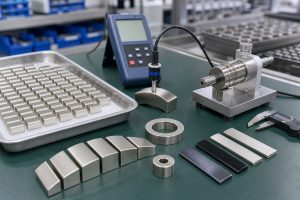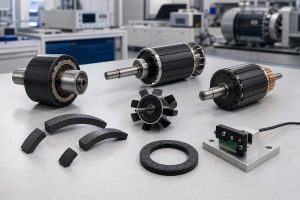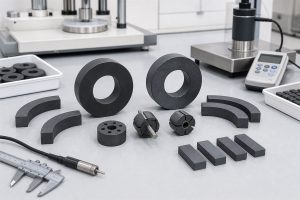


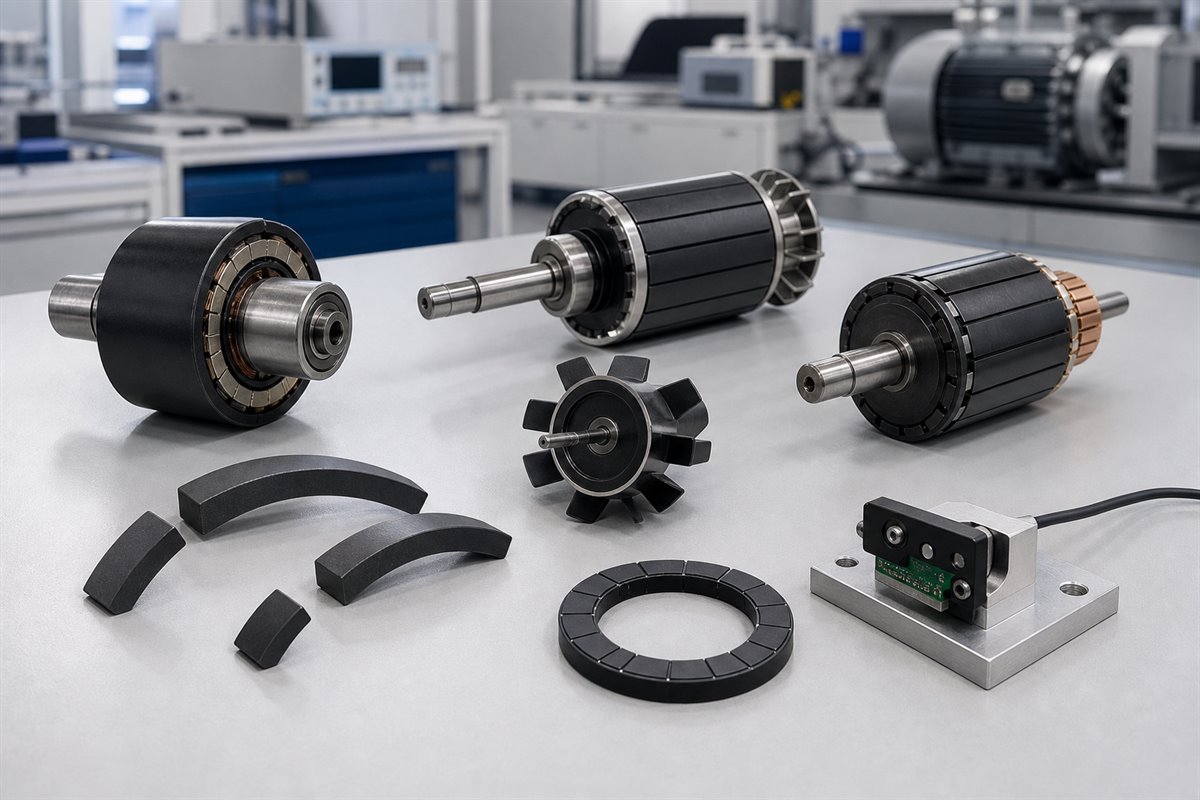
Looking for a magnetic assembly manufacturer in 2026? You’ve probably noticed it’s not getting easier. Lead times are longer, rare-earth pricing keeps moving, and more suppliers claim they can do everything. Then you send them a drawing, and the questions start.
So instead of ranking companies by size, we looked at ten manufacturers and asked a more practical question. Who actually fits what kind of project?
A high-speed rotor is not the same job as a holding magnet. A medical subassembly is not the same as a molded sensor ring. The right partner depends on your drawing, volume, environment, and how you plan to validate the finished part.
Here are ten magnetic assembly manufacturers in 2026, and where each one tends to fit.
How We Selected These Magnetic Assembly Manufacturers
This is not a revenue ranking or a claim that one company is universally “best.” We reviewed publicly available 2026 information and looked for four things: real assembly capability, engineering support, relevant production processes, and experience with demanding applications.
We also favored companies that discuss the complete magnetic circuit. That matters because a magnetic assembly combines magnets with parts such as shafts, hubs, steel return paths, housings, sleeves, adhesives, or molded polymers. The final result depends on geometry, air gap, mechanical retention, magnetization, and testing—not just the magnet grade. For a useful primer, see what magnetic assemblies are and how to select them.
Top Magnetic Assembly Manufacturers
1. Chase Technology
Chase Technology supports custom magnetic parts and functional assemblies from material selection through production validation. Its capabilities include injection-molded magnets, compression-bonded magnets, sintered magnets, insert molding, tooling, magnetic simulation, magnetization, and assembly testing.
It is a practical option for integrated rotors, multipole sensor rings, pump components, automotive parts, and compact assemblies where geometry and magnetic performance must be developed together.
2. Arnold Magnetic Technologies
Arnold Magnetic Technologies produces precision magnetic assemblies using NdFeB, SmCo, Alnico, and other materials. Its published capabilities include magnet fabrication, hubs and sleeves, thermal stabilization, dynamic balancing, magnetic characterization, and system integration.
Arnold is especially relevant for aerospace, defense, oil and gas, automotive, and high-performance motor programs. Buyers who need a dynamically balanced rotor, Halbach array, pump coupling, or high-temperature SmCo assembly should put it on the shortlist.
3. Dexter Magnetic Technologies
Dexter Magnetic Technologies focuses on engineered magnetic assemblies for demanding environments. It supports material and coating selection, load-line analysis, fabrication, magnetization, field mapping, and final assembly. Dexter also publishes capabilities for micro, small, and large assemblies, plus ISO 7 cleanroom work.
That range makes Dexter a strong candidate for medical, semiconductor, aerospace, defense, and oil-and-gas projects where cleanliness, precision, documentation, and environmental performance are major parts of the specification.
4. Dura Magnetics
Dura Magnetics offers both stock and engineered-to-order assemblies. The company describes a development path that includes concept validation, 2D and 3D magnetic modeling, prototyping, empirical testing, and production transfer.
Dura is worth reviewing when you need a U.S.-based engineering team for custom holding assemblies, magnetic circuits, or low-to-medium-volume precision work. Its in-house machining, CMM inspection, magnetizing, grinding, encapsulation, and isolated assembly capabilities can reduce handoffs during development.
5. Integrated Magnetics
Integrated Magnetics provides design-to-spec and build-to-print permanent magnets, precision assemblies, rotors, Halbach arrays, actuators, sensors, and custom electrical machines. It describes vertically integrated engineering, manufacturing, assembly, and final testing across facilities in the United States and Mexico.
This supplier is a natural fit for technical and mission-critical programs that need more than a bonded magnet in a housing. Think high-speed rotors, motion systems, aerospace hardware, medical equipment, and complete electromechanical components.
6. Magnet Applications
Magnet Applications, part of the Bunting group, presents itself as a one-stop source for engineered assemblies. Its services span magnetic design, bonded-magnet compounding, insert and overmolding, rapid prototyping, fabrication, bonding, fastening, potting, magnetizing, and final testing.
It may be a good match for high-volume bonded-magnet programs, sensors, switches, automotive parts, medical devices, and applications that benefit from automated assembly. Buyers looking for both magnet materials and production-scale integration should take a closer look.
7. Adams Magnetic Products
Adams Magnetic Products combines a large stock range with custom fabrication and assembly. It can work from a customer print or help streamline a design, then source the magnets, precision metal parts, coatings, fasteners, and other components needed for a finished subassembly.
Adams is particularly useful when a project sits between a standard catalog product and a fully custom magnetic system. Its range covers holding and mounting devices as well as engineered parts for industrial, medical, aerospace, automotive, and retail applications.
8. Alliance LLC
Alliance LLC supplies permanent magnets and produces custom assemblies such as high-speed motor rotors, precision sensing devices, Halbach arrays, and magnetic couplings. The company also offers bonded magnets made with materials such as NdFeB, ferrite, and SmCo in engineering polymers.
That combination is attractive for motor and sensor designers who want quick-turn development plus a path to custom production. It is also useful when the application may benefit from a molded magnet rather than a conventional sintered part.
9. Eclipse Magnetics
Eclipse Magnetics designs custom magnetic assemblies and subassemblies from one-off prototypes through mass production. Its public examples include pump couplings, Halbach arrays, sensor solutions, rotors, and audio equipment subassemblies.
Eclipse deserves attention when the project needs application consultation and a commercially practical design. It discusses targets such as force, torque, field strength, temperature, weight reduction, miniaturization, and cost—not just magnet dimensions.
10. Magma Magnetic Technologies
Magma Magnetic Technologies designs, prototypes, and manufactures magnetic assemblies, including rotors, couplings, holding magnets, plastic-integrated magnets, full magnetic rings, dipoles, and Halbach arrays. It also offers magnetic simulation, laboratory services, and custom engineering.
Magma can be a useful option for specialized R&D work and lower-volume technical projects. Its radial sintered ring experience may be particularly relevant to teams developing compact motors, encoders, or unusual multipole systems.
Magnetic Assembly Manufacturer Comparison
| Manufacturer | Notable strength | Good project fit |
|---|---|---|
| Chase Technology | Molded, sintered, and integrated magnet solutions | Custom rotors, sensors, pumps, automotive parts |
| Arnold | Precision and high-temperature assemblies | Aerospace, motors, couplings, Halbach arrays |
| Dexter | High-precision and cleanroom assembly | Medical, semiconductor, defense |
| Dura Magnetics | Concept-to-production engineering | Custom magnetic circuits and precision builds |
| Integrated Magnetics | Vertically integrated electromechanical systems | Rotors, actuators, sensors, mission-critical parts |
| Magnet Applications | Bonded magnets and scalable assembly | Automotive, medical, sensors, volume programs |
| Adams Magnetic | Stock-to-custom flexibility | Holding, mounting, and engineered subassemblies |
| Alliance | Rotors, sensor magnets, bonded materials | Motors and sensing applications |
| Eclipse Magnetics | Application-led custom assembly design | Couplings, sensors, rotors, industrial systems |
| Magma | Specialized engineering and radial rings | R&D, encoders, motors, custom devices |
How to Choose a Magnetic Assembly Manufacturer
Begin with the finished assembly requirement. Share the target field, force, torque, waveform, or sensor output at the real working air gap. Add the temperature range, speed, corrosion exposure, shock, vibration, dimensions, tolerances, annual volume, and expected service life.
Then ask who owns each critical process. Does the supplier design magnetizing fixtures? Can it balance a rotor, control adhesive bond gaps, mold around an insert, machine the steel path, and measure the final field? A capable magnetic assembly manufacturer should explain how these steps connect.
Check Validation and Quality Controls
Request a control plan that covers incoming magnet material, dimensions, coating or polymer condition, polarity, magnetization, bond strength, runout, balance, and final magnetic output. For automotive work, ask about PPAP and change control. For regulated or mission-critical projects, review traceability, cleanliness, calibration, and documentation early. Chase Technology’s magnet quality-control overview offers a useful starting checklist.
Compare Total Cost, Not Piece Price
A cheaper magnet can create a more expensive assembly. Extra spacers, manual alignment, secondary machining, field sorting, or scrap can erase the saving. An integrated bonded magnet or an assembly magnetized after joining may reduce parts and improve repeatability. Ask suppliers to show the tradeoff across tooling, labor, yield, inspection, and lifetime performance.
Discuss Your Magnetic Assembly Project
Every good magnetic assembly project starts with a conversation, not a catalog number. You don’t need a finished drawing or a full specification to reach out. Tell us what the assembly needs to do, and our engineering team can help you work through the magnet, the air gap, the tolerances, and the validation plan from there. If you have a project in mind, we’d like to hear about it. Get in touch and let’s talk through the details.

FAQs
What Does a Magnetic Assembly Manufacturer Do?
A magnetic assembly manufacturer combines permanent magnets with mechanical or magnetic components to create a functional unit. Typical work includes design, material selection, machining, bonding, overmolding, magnetization, balancing, field measurement, and final testing.
Which Company Is Best for Custom Magnetic Assemblies?
The best company is the one whose routine processes match your application. Chase and Magnet Applications are strong in molded and integrated parts. Arnold, Dexter, and Integrated Magnetics suit precision or mission-critical systems. Dura, Adams, Alliance, Eclipse, and Magma cover other useful combinations of engineering and production support.
Can a Manufacturer Test the Complete Assembly?
Yes, but capabilities vary. Ask about flux measurement, field mapping, torque or force testing, runout, balance, environmental testing, bond verification, and end-of-line fixtures. Agree on test conditions and pass/fail limits before tooling begins.