

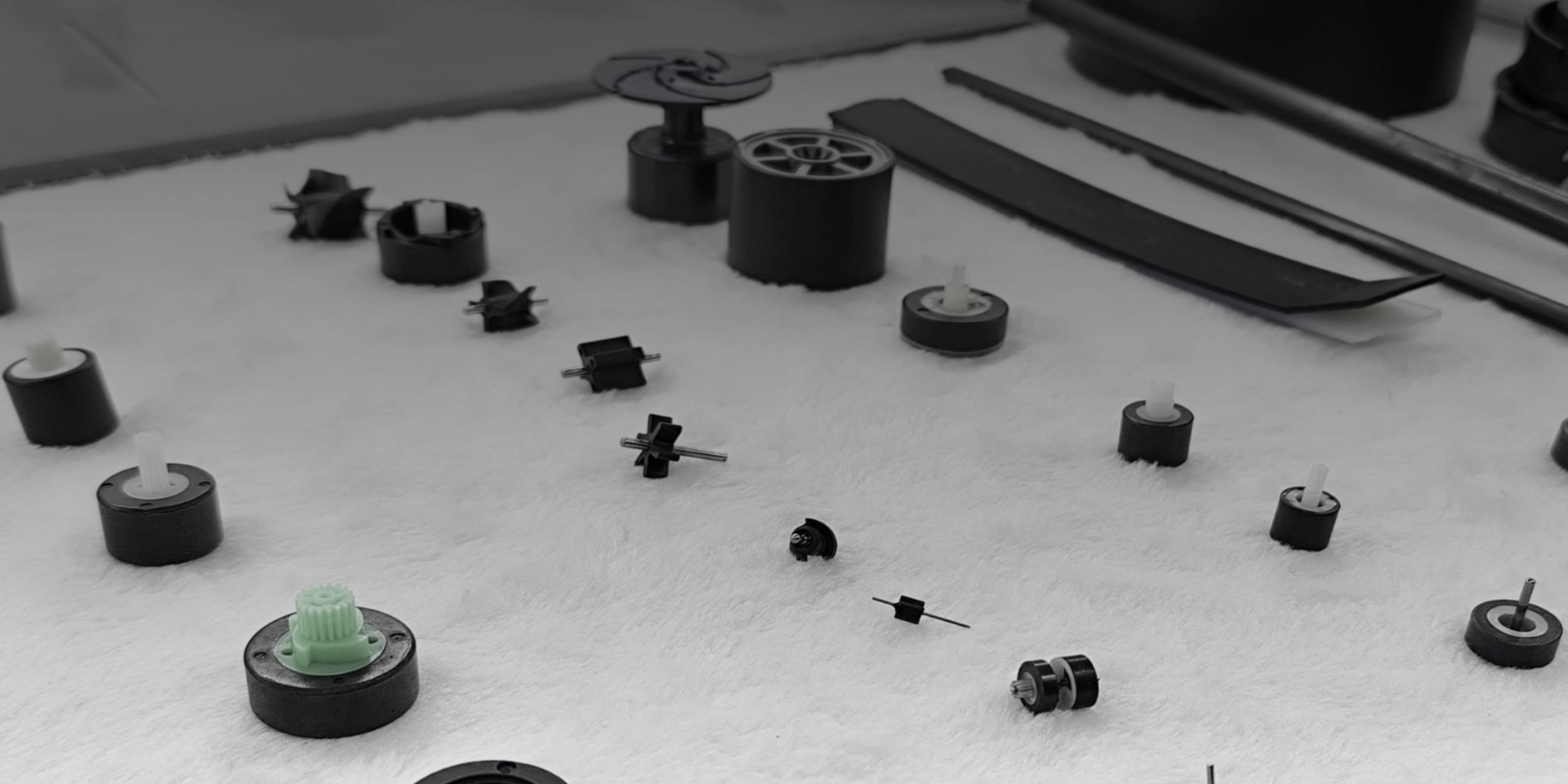
You’ve got a motor rotor that needs eight magnetic poles, a housing that wraps around a steel shaft, and a tolerance spec that leaves zero room for glue-ups or post-machining. Sound familiar? That’s exactly where injection molded magnets earn their place on the spec sheet.
In this post, we’ll walk you through the practical reasons design engineers and procurement teams keep choosing injection molded magnets over traditional alternatives.
What Are Injection Molded Magnets?
Injection molded magnets are produced by blending magnetic powder with a thermoplastic binder, which allows the resulting compound to be injection molded in the same manner as any other plastic. The magnetic powders typically include NdFeB (neodymium iron boron), ferrite, or SmFeN, and the binder is usually PA6, PA12, or PPS, depending on the operating temperature and mechanical demands.
Here’s the thing: they’re not the strongest magnet type on the market. Bonded magnets, while versatile, generally have lower magnetic properties compared to their sintered counterparts. But raw magnetic strength isn’t always the deciding factor. When you need complex geometry, tight dimensional control, and easy integration with other parts, bonded magnets win on total system cost and design flexibility.
Related article: Sintered vs. Injection Molded Magnets: A Technical Comparison
6 Reasons to Choose Injection Molded Magnets
1. Design Flexibility
This is the big one. The injection molding process permits the production of intricate shapes and detailed features that would be difficult or costly to achieve with other techniques. Sintered magnets? They are created by compacting powder at extreme temperatures, resulting in maximum magnetic strength but a brittle structure limited to simple shapes.
2. Built-In Corrosion Resistance
Because injection molded magnets contain a high content of polymer binder, they have strong corrosion resistance and typically do not require surface coating protection. That’s a direct cost savings. Skipping the coating step removes a supplier, a lead-time window, and a potential failure point from your BOM. Pretty solid trade-off.
3. Tight Tolerances Without Secondary Machining
Injection molded magnets have dimensions consistent with the injection mold cavity, enabling relatively high control over product size accuracy. In our experience, most parts come off the tool ready to assemble, with no grinding, wire cutting, or additional dimensional adjustment required.
For high-volume sensor rings and motor rotors, that matters. It means less scrap, fewer inspection bottlenecks, and faster time to line.
4. Over-Molding and Insert Molding
This is where injection molded magnets really pull ahead in system-level design. Magnets can be molded directly onto or around other components like shafts, housings, or lead frames. This creates a single, integrated component, eliminating the need for adhesives, fasteners, and the labor required to assemble them.
5. Multi-Pole Magnetization in a Single Part
Injection molding technology can produce both isotropic and anisotropic magnets. Anisotropic magnets require an external orientation magnetic field during molding to orient the magnetic powder in the molten polymer to achieve orientation and multipole magnetization.
6. Stable Global Supply Chain
Injection molded magnets typically use bonded NdFeB or ferrite-based powder systems and contain little to no heavy rare earth elements such as dysprosium (Dy) or terbium (Tb), which are often subject to supply constraints in traditional sintered rare earth magnets.
This makes them less dependent on restricted materials and more stable in global sourcing environments.
As a result, manufacturers benefit from:
- More predictable raw material supply chains
- Fewer export and regulatory limitations
- Easier global production and distribution strategies
This is particularly important for industries requiring stable long-term sourcing, such as automotive, sensors, and industrial automation.
Where Are Injection Molded Magnets Used?
The application range is broader than most people expect. Below are some common applications:
- Automotive: ABS sensor rings, turbocharger water pump components, gear position sensors
- Home Appliances: Brushless DC motor rotors for washing machines, refrigerators, and air conditioners
- Industrial: High-speed motor components, robot joint sensors, power tool rotors
- Consumer Electronics: Magnetic charging cables, wireless magnetic C-rings, smart device components
Over the past several decades, injection molded magnets have been widely applied in household appliances, office automation equipment, consumer electronics, and the automotive industry. And the demand keeps growing, especially as EV platforms and smart home devices push for lighter, more integrated magnetic parts.

Conclusion
Injection molded magnets won’t replace sintered magnets in every application. But they solve a very specific and very common set of engineering problems: complex shapes, tight tolerances, corrosion resistance, multi-pole magnetization, and stable global supply chain. When you factor in over-molding and part consolidation, the total system savings can be significant.
Bonded magnets are one of the most underrated tools in a design engineer’s toolkit. If you’re working on a motor, sensor, or magnetic assembly project and want to explore what injection molded magnets can do, our team at Chase Technology is here to talk through your application.
FAQs
Are injection molded magnets strong enough for motor applications?
Yes. While bonded magnets have lower BHmax than sintered types, they work well in brushless DC motors, sensor rotors, and small to mid-size motor applications. Magnetic powders are evenly distributed within the binder, yielding consistent magnetic performance throughout the part. For applications demanding moderate magnetic output and high dimensional accuracy, they’re a strong fit.
What magnetic materials can be injection molded?
The three main families are ferrite, NdFeB (neodymium iron boron), and SmFeN (samarium iron nitrogen). Each is compounded with thermoplastic binders like PA6, PA12, or PPS.
Do bonded magnets need surface coating?
This type of magnets are more resistant to corrosion than sintered materials, for this reason they can be used in most applications without special coatings. The polymer binder acts as a built-in protective layer. That said, some demanding environments may still warrant additional surface treatment—it depends on the specific conditions.
How do injection molded magnets compare on cost?
Bonded magnets are generally cheaper to produce due to simpler manufacturing and lower raw material requirements. The real savings show up at volume: no secondary machining, no coating, and the ability to consolidate multiple parts into one molded piece. Tooling has an upfront cost, but it pays back quickly in high-volume runs.