

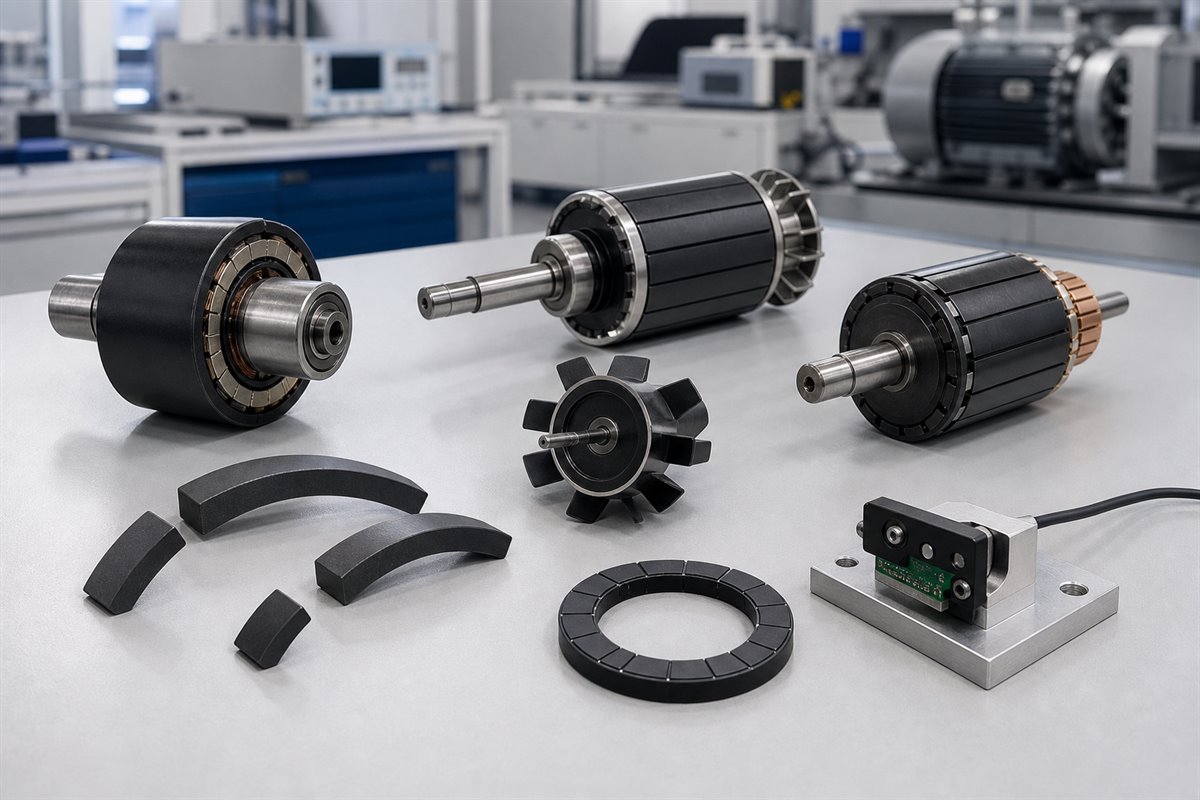
Magnets for electric motors turn electrical energy into controlled rotation by creating the magnetic field that the stator pushes or pulls against. The right choice depends on speed, torque, heat, rotor space, noise, assembly method, and cost.
This guide covers six electric motor magnet applications OEM teams should know before choosing ferrite, bonded NdFeB, sintered NdFeB, SmFeN, or a custom magnetic assembly.
What Do Magnets Do in Electric Motors?
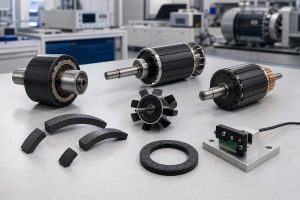
In a permanent magnet motor, rotor magnets provide a stable field while the stator windings create a moving field. Their interaction produces torque, so magnet geometry, grade, pole pattern, and assembly accuracy affect efficiency, vibration, heat rise, and life.
The U.S. Department of Energy describes vehicle permanent magnet motors as rotor magnets and current-carrying stators separated by an air gap. For OEM design, ask which magnet format works inside the motor, not only which grade is strongest.
| Motor magnet option | Typical advantage | Common design concern |
|---|---|---|
| Ferrite magnets | Cost control, corrosion resistance, stable supply | Larger volume may be needed for the same torque |
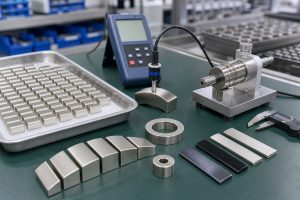
| Sintered NdFeB magnets | High magnetic output in compact motors | Retention, coating, temperature, and cracking risk |
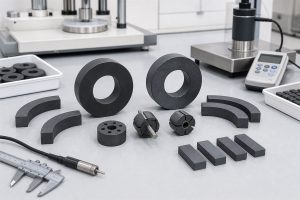
| Bonded ring magnets | Complex shape, multi-pole pattern, integrated rotor design | Lower magnetic strength than sintered rare-earth magnets |
| Injection molded magnets | Insert molding, overmolding, repeatable part geometry | Tooling, compound selection, and magnetization design |
Six Motor Magnet Applications OEM Teams Should Know
1. BLDC Motor Rotor Magnets for Compact Drives
BLDC motor rotor magnets are used in drones, pumps, fans, power tools, smart appliances, and compact automation drives. Sintered arc magnets and bonded ring magnets can both work, but they solve different production problems.
Best magnet formats for BLDC motors
Sintered NdFeB arc segments are attractive when torque density is the main target. Bonded or injection molded magnets help when the rotor needs a continuous ring, precise pole count, lower part count, or integration with a sleeve, hub, or shaft. Test back EMF, cogging torque, balance, and assembly.
2. High-Speed Motor Magnets for Power Tools and Appliances
High-speed motor magnets appear in hair dryers, vacuum cleaners, power tools, turbo blowers, and compact fans. These motors can run at tens of thousands of RPM, so centrifugal stress and rotor balance matter as much as magnetic output.
A high-energy sintered magnet can reduce rotor size, but it may need a retaining sleeve, coating, adhesive control, and careful handling. Bonded rings or overmolded rotors may fit better when the design needs stable dimensions or fewer loose pieces. The trade-off is lower remanence.
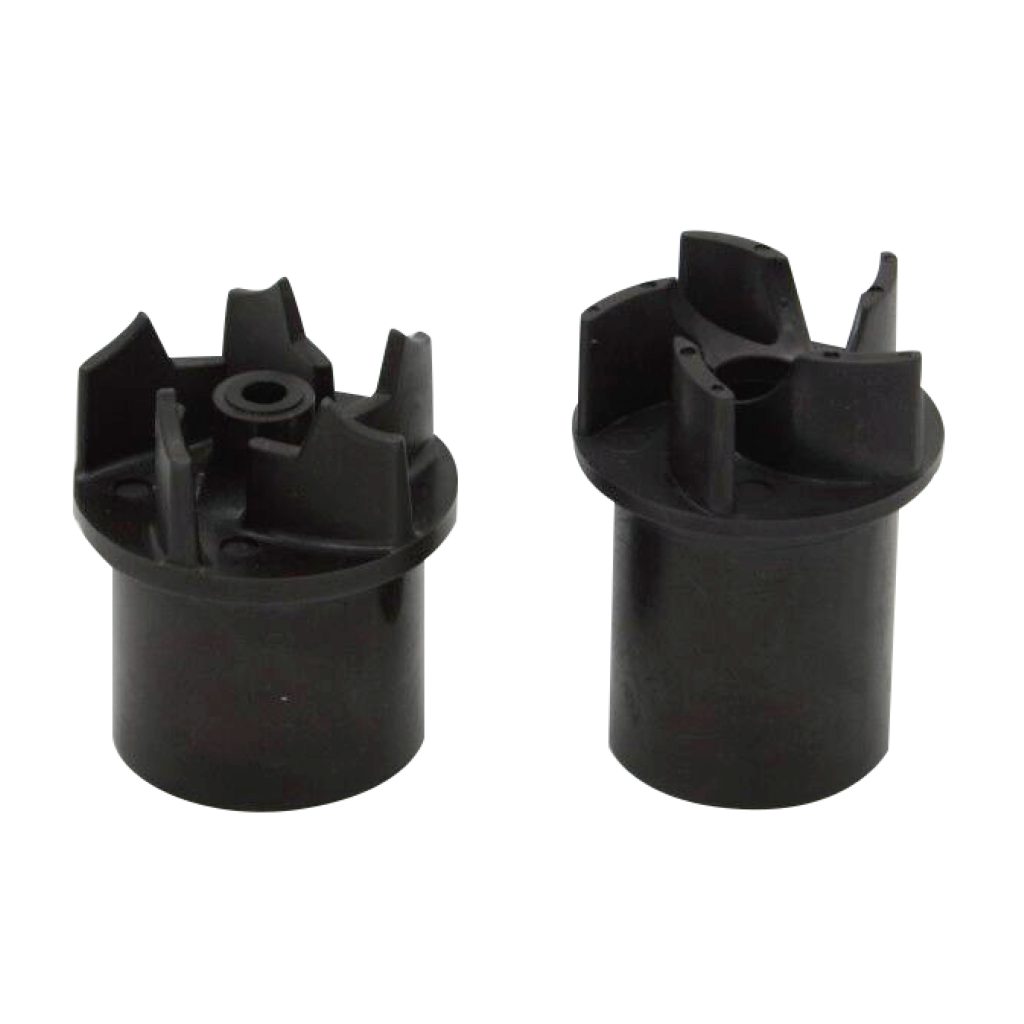
3. Cooling Water Pump Rotor Magnets for EV Thermal Systems
Cooling water pump rotor magnets work in harsher conditions than many dry motors. The magnet may sit close to coolant, heat, vibration, and long duty cycles, so the rotor must hold performance while keeping the pump stable and quiet.
Ferrite/PPS bonded rotors are often chosen for cost, corrosion resistance, and thermal stability. NdFeB/PPS bonded rotors can raise torque in a smaller package, but moisture, temperature, and magnetization consistency must be controlled. Molding the impeller and magnetic rotor together can reduce part count and improve balance.
4. Fan and HVAC Motor Magnets for Quiet Rotation
Fan motor magnets are common in HVAC blowers, server fans, smart home devices, cordless appliances, and bladeless fan systems. Users may notice noise before torque, so runout, magnetization uniformity, and balance are key quality metrics.
Ferrite magnets remain practical in many fan motors because they control cost and resist corrosion. For thinner or more powerful fan drives, rare-earth magnets may shrink the motor. A custom motor rotor should still account for pole pair count, air gap, bearing stack-up, and molding deformation.
5. Servo and Robot Joint Feedback Magnets
Electric motors in robotics, servo drives, and precision actuators often need more than torque. A magnetic encoder ring or angle sensor magnet can sit on the motor shaft and provide the signal for commutation, closed-loop control, or absolute position tracking.
Motor feedback magnets need signal quality
For these magnets, field shape is the product. Pole pitch, magnetization direction, concentricity, air gap, and eccentricity can change the sensor output. In robot joints or compact servo motors, injection molded multi-pole rings can combine accurate geometry with a controlled pole pattern. For controls, see this guide on rotary angle sensors vs rotary encoders.
6. Appliance and Small Actuator Motor Magnets
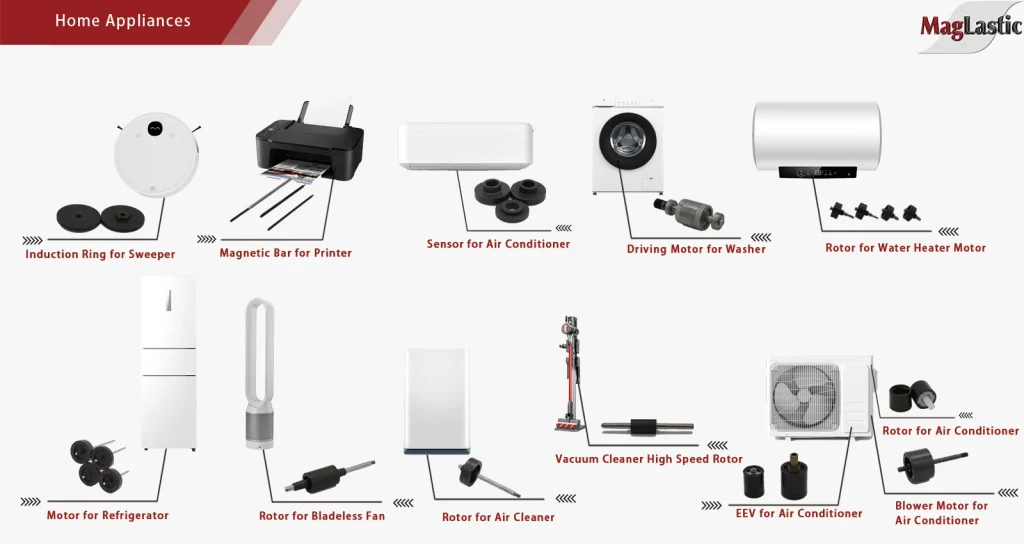
Appliance and actuator motor magnets appear in washing machines, electric curtains, smart toilet pumps, printers, locks, valves, and small geared drives. The priorities are stable supply, repeatable assembly, low noise, long life, and production cost.
This is where custom bonded magnets can be valuable. A molded magnetic rotor can integrate a shaft hole, drive feature, sleeve, or insert. Ferrite may be enough for many appliance motors, while bonded rare-earth material can help when the housing is small or starting torque is higher.
How to Choose Electric Motor Magnets for an OEM Design
Good electric motor magnet selection starts with the application, not the catalog grade. The same motor power can lead to different answers if one design prioritizes torque density, another needs coolant resistance, and another needs a multi-pole feedback signal.
Choose material by magnetic output and environment
Use ferrite when cost, corrosion resistance, and available space are favorable. Use sintered NdFeB when the motor needs high torque density and the team can manage coating, retention, and temperature. Use bonded NdFeB, SmFeN, or ferrite compounds when geometry, pole pattern, and integration matter more than maximum energy product alone.
Choose the magnet format by assembly method
Arc magnets, bonded rings, insert molded rotors, and overmolded assemblies all affect production risk. If the motor must avoid loose magnets, reduce gluing steps, or hold a multi-pole pattern on a small diameter, an integrated injection molded magnet may scale better than separate sintered pieces. If space is tight and retention is controlled, sintered magnets may still be best.
Validate the rotor, not only the magnet
Before sampling, define RPM, duty cycle, temperature, air gap, magnetization direction, pole pair count, sensor position, shaft fit, corrosion exposure, and tests. A magnet that looks correct on a drawing can still fail if the finished rotor has poor balance, uneven flux, weak retention, or a sensor signal that shifts after assembly.
For a new project, share the motor type, rotor drawing, target flux or torque, temperature range, medium exposure, and annual volume. Chase Magnet can compare ferrite, bonded rare-earth, injection molded, compression molded, and sintered options against the actual motor application.
FAQ
What magnets are used in electric motors?
Electric motors commonly use ferrite magnets, sintered NdFeB magnets, bonded NdFeB magnets, SmFeN bonded magnets, and sometimes SmCo magnets. The best choice depends on torque density, speed, temperature, corrosion risk, cost target, and how the rotor or stator is assembled.
Are ferrite magnets good for motors?
Ferrite magnets are a good fit when the motor has enough space and the design needs cost control, corrosion resistance, and stable performance. They are common in fans, pumps, appliances, and some bonded rotor designs.
When do motor rotors need NdFeB magnets?
NdFeB motor magnets are usually selected when the motor needs higher torque in a smaller package. They are often used in compact BLDC motors, servo motors, power tools, robotics, and traction-related designs where magnetic output per volume is important.
Why use bonded motor rotor magnets?
Bonded motor rotor magnets can combine magnetic material with plastic or resin, which helps create ring shapes, multi-pole magnetization, overmolded parts, and integrated pump or fan rotors. They also reduce machining compared with many sintered magnet assemblies.