

Rotary angle sensor vs rotary encoder is not just a vocabulary question. Both devices can report shaft position, but they fit different control-loop needs. The right choice depends on whether the system needs absolute angle over a limited range, continuous multi-turn position, speed feedback, high resolution, compact packaging, or reliable operation in dust, oil mist, vibration, and temperature change.
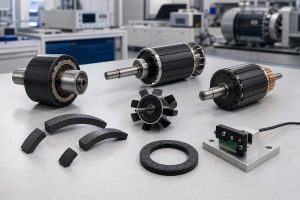
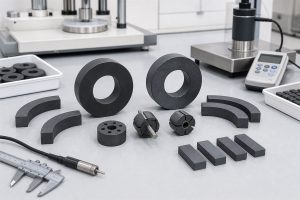
For many OEM products, the magnetic target is where the decision becomes practical. A rotary angle sensor may use a two-pole diametric magnet, ring magnet, or molded magnetic target near a Hall, AMR, GMR, or TMR chip. A rotary encoder may use a multipole magnetic ring, code wheel, or optical disk. Before selecting the electronics, engineers should define what the control loop actually needs to know.
What Is a Rotary Angle Sensor?
A rotary angle sensor measures angular position, often within a defined mechanical range such as 0-90 degrees, 0-180 degrees, or 0-360 degrees. In a magnetic design, the sensor IC reads the field vector from a nearby magnet and converts it into an output signal.
This approach is useful when the system needs compact absolute position feedback rather than a long count history. Common examples include throttle position, valve position, actuator angle, HVAC flap position, gear position, steering sub-assemblies, small robotic joints, and other mechanisms where the controller must know the current angle immediately after power-up. Chase Magnet’s angle sensor magnet solutions are typically designed around magnet geometry, air gap, temperature, sensor package, and assembly tolerance.
What Is a Rotary Encoder?
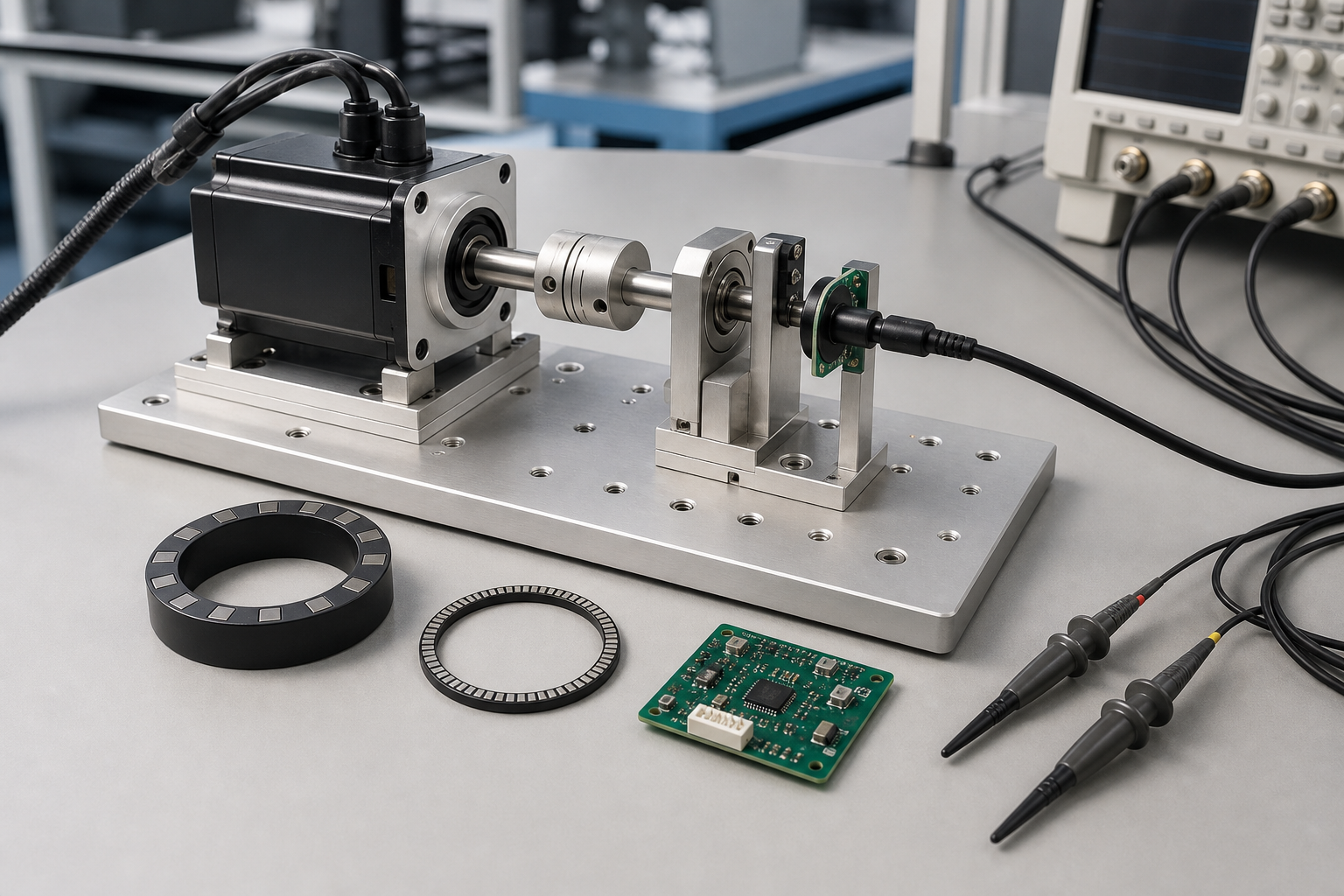
A rotary encoder converts shaft rotation into position, speed, or direction information. Incremental encoders generate pulses as the shaft moves, while absolute encoders provide a unique position value. Magnetic encoders often use a multipole ring magnet or magnetized wheel; optical encoders use light and a patterned disk.
Encoders are common in servo motors, robotics, CNC axes, conveyors, automated equipment, and motion platforms where the controller needs continuous feedback, high resolution, speed calculation, or multi-turn tracking. If the design uses a magnetic encoder, pole pitch, concentricity, air gap, runout, and interpolation all affect control quality. For more detail, see Chase Magnet’s guide to magnetic encoder magnets.
The Main Difference: Angle State vs Motion Feedback
A rotary angle sensor is often selected when the controller needs a direct angle state. The system asks, “Where is this shaft or flap right now?” A rotary encoder is often selected when the controller needs motion feedback over time. The system asks, “How far and how fast has this shaft moved?”
That distinction is not absolute. Some angle sensors support full 360-degree absolute measurement, and some encoders provide absolute position. Still, angle sensors usually win on compactness and direct absolute output, while encoders usually win on resolution, speed feedback, and continuous rotation control.
When a Rotary Angle Sensor Fits Better
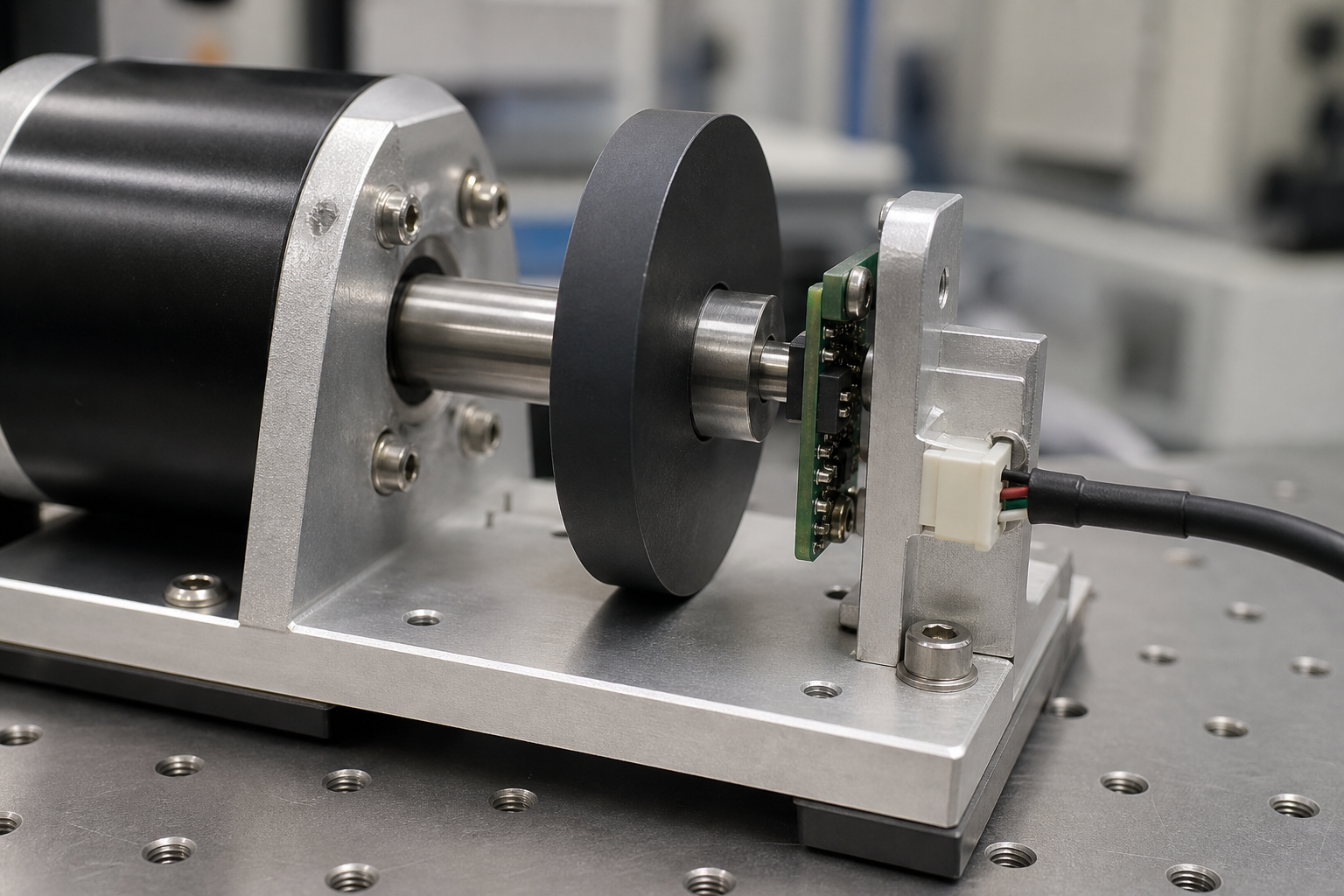
Choose a rotary angle sensor when the movement range is limited or when the control unit must know position immediately after start-up. It is also a strong fit when the mechanical package is small, sealed, or exposed to contamination that would make an optical path difficult to protect. A magnetic angle sensor can be built into a compact assembly with a molded magnet, shaft, bracket, and sensor board.
This choice is attractive when the required accuracy is moderate but robustness is important. A valve actuator may not need thousands of counts per revolution, but it does need stable output through vibration, temperature cycling, moisture, and assembly variation. In that case, magnet material, magnetization direction, offset, and sensor saturation margin matter more than headline resolution.
When a Rotary Encoder Fits Better
Choose a rotary encoder when the control loop needs high-resolution motion feedback, speed measurement, direction detection, or continuous rotation. Servo motors, precision positioning axes, and robotics often need feedback that supports acceleration control, velocity loops, and tight positioning. In these systems, missing counts, eccentric magnetization, pole pitch error, or excessive runout can create ripple, noise, or unstable control behavior.
A magnetic rotary encoder can be more tolerant than an optical encoder in dirty environments, but it still needs careful magnetic design. The ring magnet or target wheel must match the IC, pole count, air gap, tolerance, and temperature range. If it sits inside a motor or compact actuator, the magnet may also need to survive press-fit forces, balancing, adhesive cure, thermal shock, and vibration.
Selection Checklist for the Control Loop
| Design Question | Often Points Toward |
|---|---|
| Does the controller need position immediately after power-up? | Rotary angle sensor or absolute encoder |
| Is the movement limited to a defined mechanical angle? | Rotary angle sensor |
| Does the system need speed and direction feedback during continuous rotation? | Rotary encoder |
| Is the packaging very compact or sealed? | Magnetic rotary angle sensor |
| Is high pulse count or fine interpolation required? | Rotary encoder |
| Will oil, dust, condensation, or vibration be present? | Magnetic sensor or magnetic encoder design |
Magnet Design Is Part of the Sensor Choice
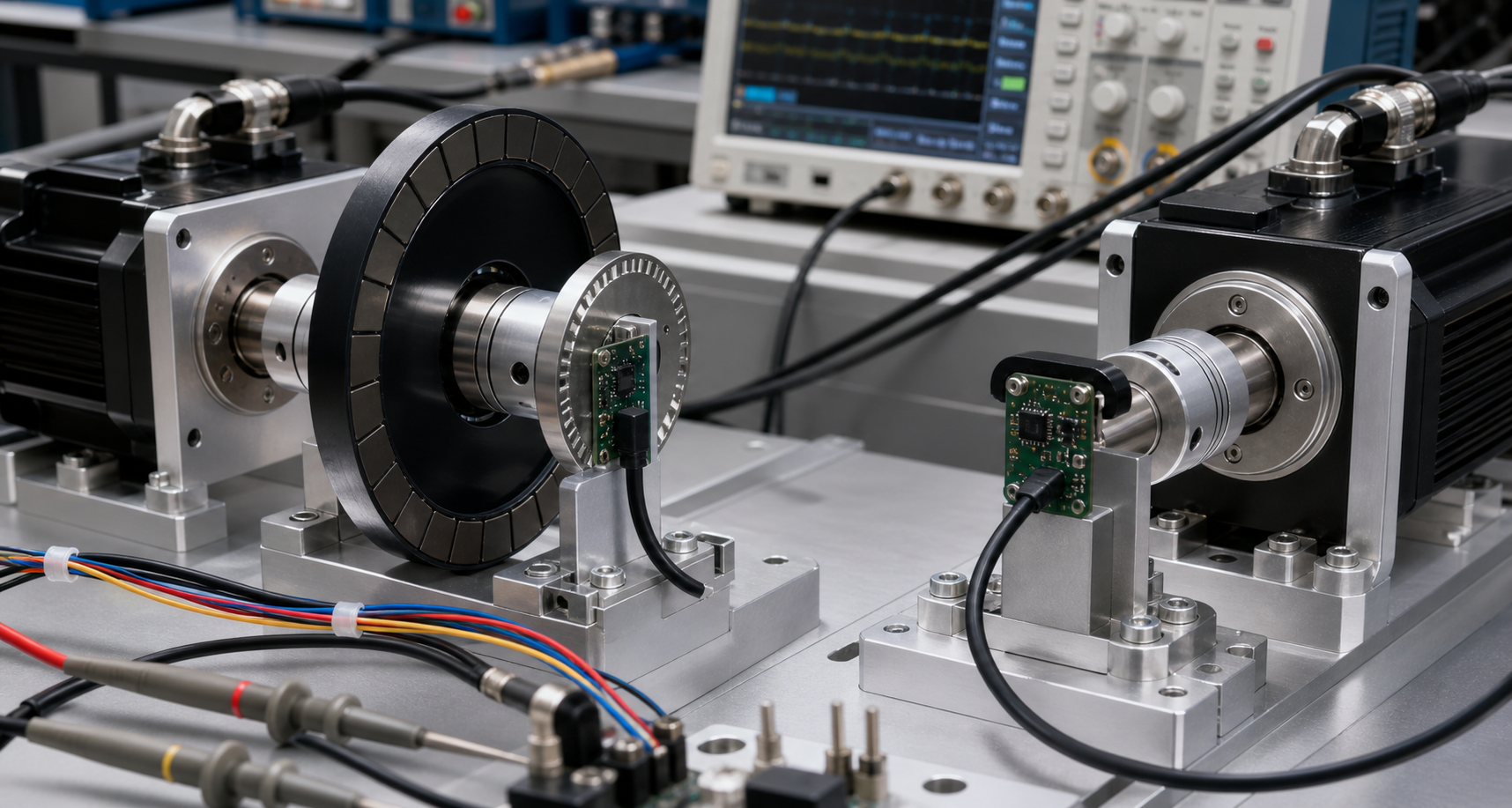
The sensor IC or encoder chip does not work alone. The magnetic component determines field strength, harmonic content, signal symmetry, and sensitivity to assembly error. A two-pole magnet for an angle sensor must keep the field vector inside the IC’s usable range across the full air gap and temperature window. A multipole encoder ring must keep pole pitch, concentricity, and magnetization uniformity under control.
For high-volume OEM programs, custom molded magnets can reduce risk. Injection-molded or bonded magnetic parts can integrate the magnet with a hub, shaft interface, gear, or plastic carrier, helping control position and reduce assembly steps. Sintered magnets may offer stronger output, while bonded magnets may offer better geometry freedom and lower chipping risk. Chase Magnet supports magnetic circuit simulation for sensor and motor assemblies.
How to Choose Between a Rotary Angle Sensor and a Rotary Encoder
If the device needs to know the angular state of a shaft, lever, valve, or joint within a compact mechanism, start with a rotary angle sensor. If the device needs continuous motion feedback, speed control, or high-resolution positioning, start with a rotary encoder. If the system needs both immediate absolute position and high dynamic feedback, compare an absolute encoder or a combined sensing architecture.
The final decision should come from the control-loop requirement, not from the sensor name. Define angle range, resolution, latency, power-up behavior, environment, air gap, tolerance, temperature, and production volume. Then select the magnet, sensor IC, assembly process, and validation plan together.
Contact Chase Magnet with your shaft layout, angle range, air gap, temperature requirement, and annual volume to review a practical magnet and sensing target design for your control loop.
FAQ
Is a rotary angle sensor the same as a rotary encoder?
No. A rotary angle sensor usually reports angular position directly, while a rotary encoder is often used for counts, speed, direction, or high-resolution motion feedback. Some absolute encoders overlap with angle-sensor use cases.
Which is better for a servo motor control loop?
A rotary encoder is usually better for servo motor feedback because the controller often needs continuous position, speed, and direction data. A rotary angle sensor may fit compact actuators or limited-angle joints.
Can a magnetic angle sensor measure 360 degrees?
Yes, many magnetic angle sensor ICs can measure a full 360-degree angle with a suitable magnet. Accuracy depends on magnet quality, air gap, alignment, temperature, and calibration.
What magnet is used for a rotary angle sensor?
Common choices include diametrically magnetized disk magnets, ring magnets, and custom molded magnetic targets. The best option depends on the sensor IC, shaft geometry, package space, and required output stability.