

Radial and axial rare earth ring magnets can look almost identical on a drawing. Their magnetic fields do not. One works through the cylindrical wall. The other works through the flat faces. That difference changes the air gap, sensor position, torque path, magnetizing fixture, assembly method, and cost.
So, which is better? Neither one wins every time. The better choice is the one that puts a stable, useful field where your product needs it. Let’s compare them without turning the answer into a physics lecture.
What Are Rare Earth Ring Magnets?
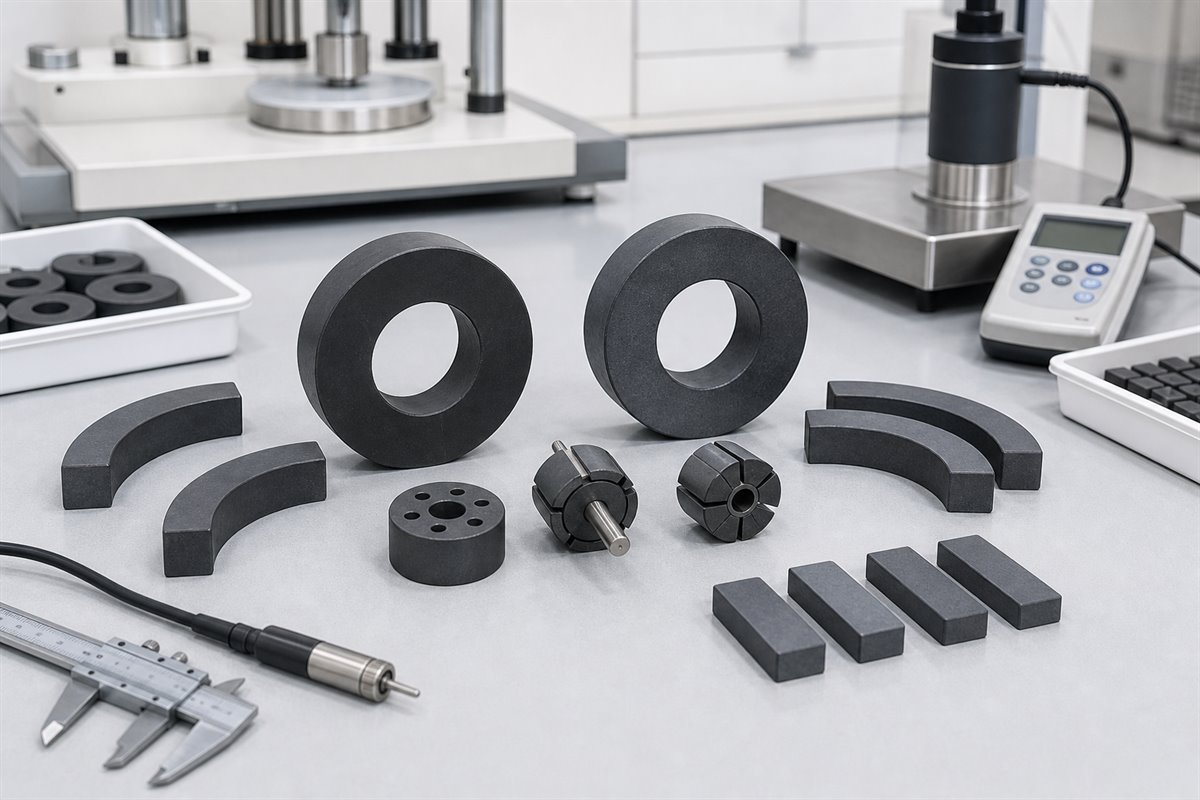
Rare earth ring magnets are annular permanent magnets made mainly from NdFeB or SmCo. The center hole can clear a shaft, reduce weight, support a bearing, or create a through-bore for a sensor. Common uses include motors, encoders, magnetic couplings, speakers, pumps, and holding assemblies.
The ring shape alone does not define the field. Three details matter: the material’s preferred orientation, the final magnetization direction, and the pole pattern. A ring can be axial, radial, diametrical, or multipole. Those terms are not interchangeable.
What Is an Axial Rare Earth Ring Magnet?
An axial ring magnet is magnetized parallel to its center axis. In a simple two-pole version, one flat face is north and the opposite face is south. The useful working gap is normally above or below the ring.
This layout is straightforward to magnetize and inspect. It works well when a sensor faces the end of a shaft, when two rings couple face to face, or when the magnet provides an axial holding force. Face multipole patterns are also possible. In that case, alternating poles form a circular track on one or both flat faces.
What Is a Radial Rare Earth Ring Magnet?
A radial ring magnet is magnetized through its wall. For a simple radial pattern, the inner diameter and outer diameter form the working pole surfaces. For a radial multipole ring, north and south poles alternate around the circumference.
The cylindrical surface makes radial magnetization attractive for rotors, torque couplings, and sensors mounted beside a rotating shaft. It can provide a continuous 360-degree working area. A one-piece ring can also replace several bonded arc magnets, which reduces placement and pole-spacing errors.
Radial vs. Axial Rare Earth Ring Magnets
| Design factor | Axial ring magnet | Radial ring magnet |
|---|---|---|
| Main field direction | Parallel to the center axis | Through the ring wall |
| Active surface | Flat end face | Outer or inner diameter |
| Typical air gap | Face-to-face | Cylindrical or side-facing |
| Common applications | Holding, thrust coupling, end-of-shaft sensing | Motors, radial couplings, ring encoders |
| Manufacturing | Usually simpler | Often needs specialized orientation and magnetizing tooling |
| Best reason to choose | The field is needed above or below the ring | The field is needed around the circumference |
Do not compare the two by material grade alone. An N42 radial ring is not automatically stronger than an N42 axial ring at the point that matters. Dimensions, pole count, steel in the magnetic circuit, air gap, and measurement direction all change the result.
Which Ring Magnet Is Better for Your Application?
For Motors and Rotors
Radial magnetization is usually the natural fit when a rotor works across a cylindrical air gap. The poles face the stator, and a multipole pattern can be placed around one continuous ring. Skewed patterns may also help manage torque ripple and cogging.
Axial magnetization makes more sense for axial-flux motors or face-to-face magnetic couplings. The useful flux crosses an axial gap instead of moving outward toward a stator. The motor architecture should decide the direction, not habit.
For Magnetic Sensors and Encoders
Start with sensor location. A PCB facing the end of a shaft usually favors an axial face track. A sensor beside the shaft usually favors a radial outer-diameter track. Pole count then sets the signal resolution and pole pitch.
Air gap, eccentricity, tilt, and runout can distort the waveform. Validate the complete assembly, not only a loose magnet. Our multipole magnetic encoder ring guide explains these tradeoffs in more detail.
For Holding and Magnetic Couplings
Axial rings are often the simpler choice for face-to-face attraction, fixtures, filters, and thrust couplings. They are easy to stack and easy to measure at a defined distance from the face.
Radial rings are better when torque must pass across concentric cylinders, such as a sealed pump coupling. The outer and inner members can interact without a shaft seal. Here, pole count, sleeve thickness, and radial air gap control usable torque.
How Material and Manufacturing Change the Choice
Sintered NdFeB provides high magnetic output in a compact ring. SmCo offers better high-temperature stability and corrosion resistance, although it is costly and brittle. Both routes need realistic wall thicknesses and careful handling.
True radial anisotropy can require specialized pressing, orientation, and magnetizing equipment. A multipole radial fixture is also more complex than a basic axial fixture. This matters early because the required pole pattern may affect tooling cost, minimum order quantity, and whether magnetization happens before or after assembly.
Bonded NdFeB trades some field strength for design freedom. Injection or compression molding can produce thin rings, integrated hubs, multiple poles, and repeatable pole spacing.
How to Specify Rare Earth Ring Magnets
- Mark the active surface. State whether the field is used at the top face, bottom face, outer diameter, or inner diameter.
- Define the pole pattern. Include pole count, polarity sequence, pole pitch, transition position, and any skew.
- Describe the working gap. Give minimum, nominal, and maximum distance from the real sensor, stator, or coupling member.
- Set a functional magnetic target. Use flux density at a location, torque, holding force, waveform amplitude, harmonic limit, or another assembly-level result.
- Add mechanical requirements. Include dimensions, concentricity, runout, balance, coating, retention method, speed, and temperature.
- Agree on inspection. Define the fixture, probe direction, scan path, air gap, datum, temperature, and acceptance limits.
A drawing that says only “radially magnetized” is incomplete. It may not tell the supplier whether the useful flux is on the inner or outer diameter, whether the ring has one pole pair or many, or where pole transitions must sit.
Why Work With Chase Technology?
Chase Technology supports sintered and bonded rare earth ring magnets, custom magnetizing fixtures, insert molding, rotor assembly, and magnetic inspection. Our engineers can compare axial and radial concepts before tooling begins.
We can also review the surrounding steel, air gap, pole count, temperature, and tolerance stack through magnetic simulation. That helps turn a general direction such as “radial” into a measurable production specification.
If you have a project in mind, contact us, and we’ll recommend the right direction for your requirements.
FAQs
Are Radial Ring Magnets Stronger Than Axial Ring Magnets?
Not automatically. Strength at the working point depends on material, ring dimensions, orientation, pole pattern, magnetic circuit, and air gap. Compare both designs at the actual sensor or load position.
What Is the Difference Between Radial and Diametrical Magnetization?
Radial magnetization points through the ring wall around its circumference. Diametrical magnetization creates two poles across the ring’s diameter. The terms describe different field patterns.
Can a Rare Earth Ring Magnet Have Multiple Poles?
Yes. Alternating poles can be magnetized around the circumference or on a flat face. Pole count, pole pitch, transition quality, and the sensing or motor air gap must be specified together.
Is NdFeB or SmCo Better for a Ring Magnet?
NdFeB usually gives more magnetic output for its size and is often more economical. SmCo can be better for high heat, corrosion resistance, and long-term stability. The operating environment decides.
Can Ring Magnets Be Magnetized After Assembly?
Sometimes. It can simplify handling and pole alignment, especially for bonded rotors. However, surrounding steel, electronics, fixture access, and the required magnetizing field may make post-assembly magnetization impractical.