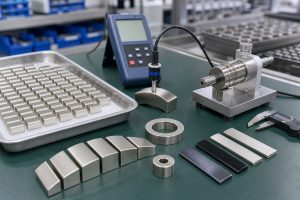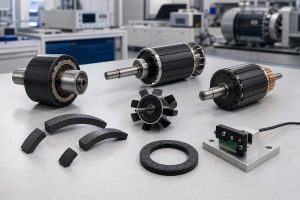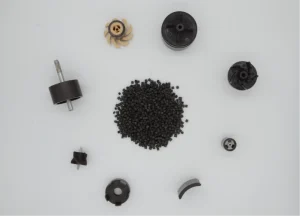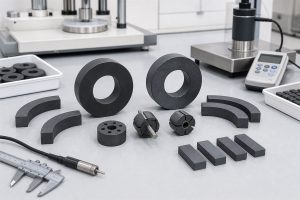


Cooling water pump rotors sit in a difficult engineering space. They must deliver magnetic torque or coupling performance, survive coolant and thermal cycling, maintain rotor balance, hold shafts or inserts reliably, and remain cost-effective at automotive production volumes. For electric vehicles and advanced thermal management systems, the rotor material is not a small detail. It influences pump size, efficiency, noise, reliability, and production yield.
Two common material directions for molded magnetic pump rotors are Ferrite/PPS and NdFeB/PPS. Both combine magnetic powder with a PPS thermoplastic binder, but they solve different problems. Ferrite/PPS usually favors cost stability, corrosion resistance, and robust production. NdFeB/PPS offers higher magnetic output in a smaller volume, but it introduces different cost, temperature, and validation questions.
This guide compares Ferrite/PPS vs NdFeB/PPS for cooling water pump rotors, turbocharged cooling water pump rotors, internal and external rotor structures, and injection molded magnetic assemblies.
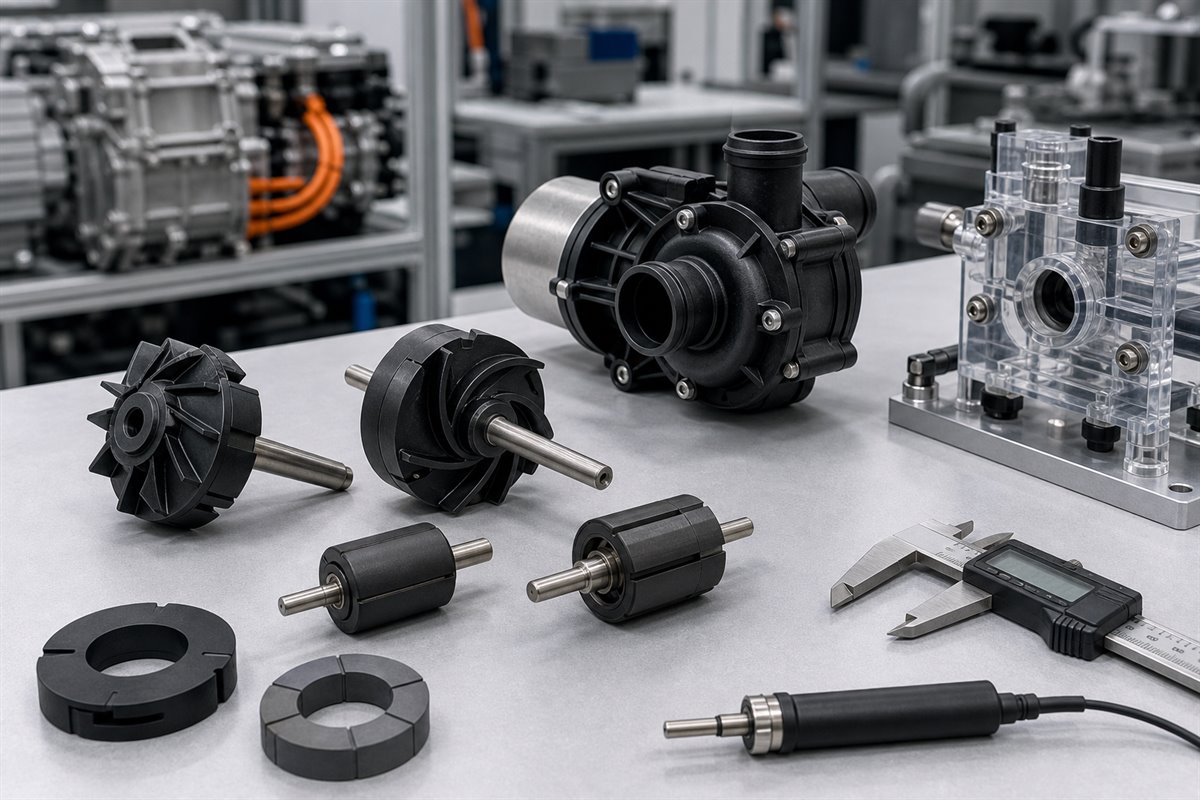
Why Pump Rotor Material Selection Is Different
A cooling water pump rotor is not only a magnet. It is a rotating magnetic assembly. The magnet may be molded around a shaft, integrated with an impeller, positioned inside a sleeve, or paired with a stator and pump housing across a defined magnetic gap. The part also works in a fluid environment where temperature, coolant chemistry, vibration, and start-stop cycles matter.
That means the best material is not simply the strongest magnet. A high-output material can still fail if the rotor is difficult to balance, if the insert shifts during molding, if the resin cannot handle the environment, or if the magnetic performance drops at temperature. A lower-output material may win if it provides enough torque with better cost, stability, and production control.
Chase Technology’s automotive application data notes that bonded magnetic compounds such as Ferrite/PPS and NdFeB/PPS can both be applied to pump rotors, including internal and external rotor structures. The blade and rotor may be injection molded together, or the magnetic rotor may be molded first and combined with a blade through secondary injection or assembly. This is exactly why material selection must include the whole rotor structure.
What Ferrite/PPS Offers
Ferrite/PPS combines ferrite magnetic powder with PPS resin. Ferrite is a hard ferrite ceramic magnetic material known for cost control, corrosion resistance, and stable behavior in many environments. PPS contributes heat resistance, dimensional stability, and chemical resistance compared with many general-purpose plastics. Together, Ferrite/PPS can be a strong candidate when the pump rotor does not require rare-earth-level magnetic output.
Ferrite/PPS is often attractive for:
- Cost-sensitive pump rotor programs
- Applications where corrosion resistance is important
- Rotors with enough magnetic volume to meet torque requirements
- High-volume injection molded production
- Parts that need stable dimensions and integrated features
- Designs where rare-earth material cost or supply risk should be avoided
The limitation is magnetic output. Ferrite has much lower magnetic energy density than NdFeB. If the pump must be compact, has a larger magnetic gap, or needs higher torque from a small rotor volume, Ferrite/PPS may require more magnet volume than the design can allow.
What NdFeB/PPS Offers
NdFeB/PPS combines neodymium iron boron magnetic powder with PPS resin. Compared with ferrite compounds, NdFeB compounds can provide much higher magnetic output. For pump rotors, this can help when the design requires more torque, smaller rotor diameter, thinner magnetic sections, or stronger coupling through a given air gap or wall thickness.
NdFeB/PPS is often considered when:
- The rotor must be compact but still produce higher magnetic torque
- The available magnetic volume is limited
- The pump design has a challenging magnetic gap
- Efficiency or startup torque cannot be met with ferrite
- The application can justify higher material cost
The tradeoff is that NdFeB/PPS needs closer validation. NdFeB is more expensive than ferrite, and rare-earth powders can be more sensitive to temperature and corrosion-related concerns than ferrite. The PPS matrix helps create a molded composite, but engineers should still verify magnetic output after thermal aging, coolant exposure, humidity, and operating temperature. Do not select NdFeB/PPS only because it is stronger on a datasheet.
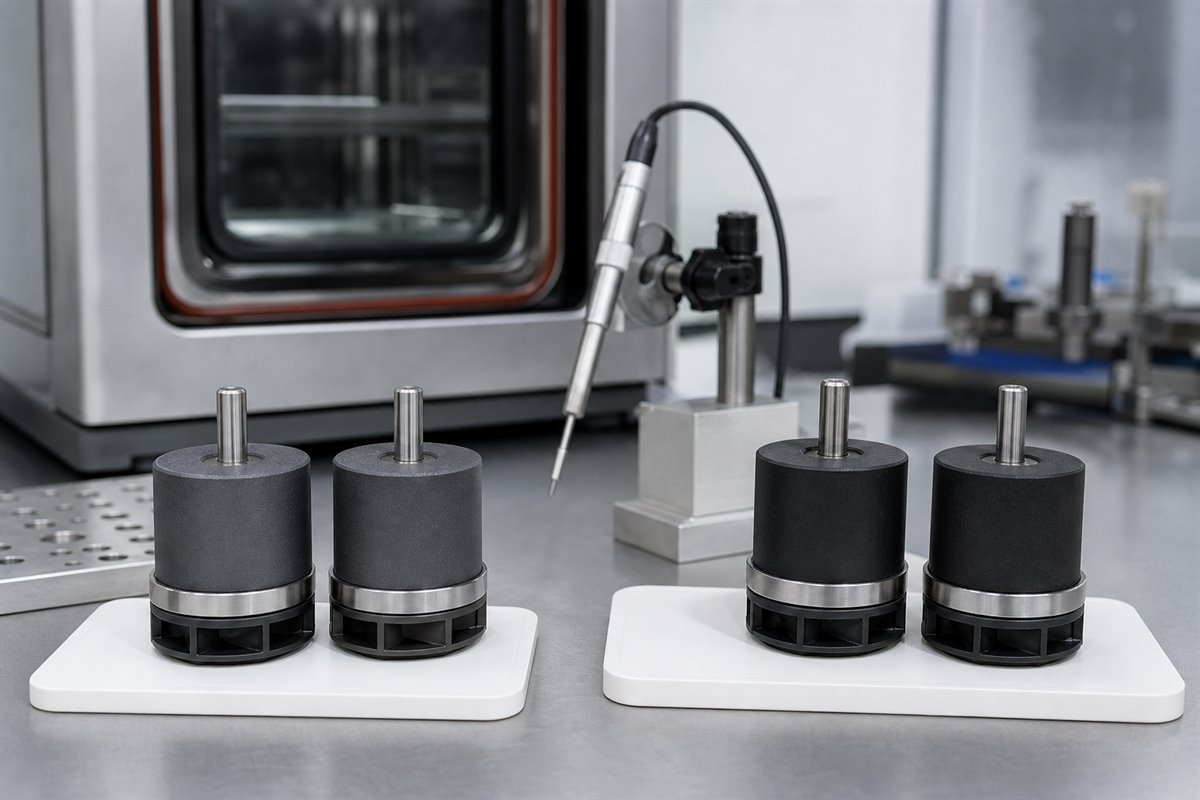
Ferrite/PPS vs NdFeB/PPS Comparison Table
| Selection Factor | Ferrite/PPS | NdFeB/PPS |
|---|---|---|
| Magnetic output | Moderate; suitable when rotor volume is sufficient | Higher; useful for compact or higher-torque designs |
| Cost | Usually more cost-effective | Higher material cost due to rare-earth powder |
| Corrosion behavior | Strong advantage because ferrite is an oxide ceramic | Must be validated carefully with coolant, humidity, and temperature |
| Temperature and demagnetization margin | Good for many pump environments if magnetic output is sufficient | Needs grade and design review to confirm high-temperature margin |
| Rotor size | May require larger magnetic volume | Can help reduce size or increase torque density |
| Best-fit design logic | Cost-stable, corrosion-resistant, high-volume pump rotors | Compact, higher-output, performance-driven pump rotors |
Internal Rotor vs External Rotor Considerations
Cooling water pump rotors can use internal or external rotor structures. In an internal rotor design, the magnetic rotor sits closer to the center of rotation. In an external rotor design, the magnetic material may sit around the outside of the rotor structure. Each architecture changes the magnetic path, available magnet volume, wall thickness, and balance requirement.
- Ferrite/PPS may be easier to justify when the design has enough space for the magnetic volume required. External rotor structures can sometimes provide more room for ferrite material.
- NdFeB/PPS becomes more attractive when the magnetic volume is restricted or the pump must deliver stronger output from a smaller rotor. However, higher output does not remove the need for balance, concentricity, and mechanical validation.
When comparing materials, engineers should calculate or simulate the magnetic circuit using the actual rotor geometry, pump housing, stator position, and working gap. A flat material comparison can be misleading if it ignores the final assembly.
Injection Molding and Assembly Routes
One advantage of molded magnetic compounds is design integration. With injection molded magnets, the rotor can include hubs, sleeves, thin features, shafts, or impeller-related geometry that would be difficult to achieve with a brittle sintered magnet ring. This can reduce assembly steps and improve dimensional consistency.
For pump rotors, there are two common routes:
- Integrated molding: the blade and magnetic rotor are molded as one part when material and tooling allow it.
- Two-step molding or assembly: the magnetic rotor is molded first, then the blade or impeller section is added through secondary injection or assembly.
Ferrite/PPS and NdFeB/PPS can both be used in molded rotor concepts, but the process window may differ. Powder loading, melt flow, shrinkage, insert stability, and gate design all influence final rotor quality. For a shaft-insert rotor, the molding process must hold the shaft position accurately. For a pump rotor, the finished assembly must also meet balance and runout requirements.
Thermal Cycling and Coolant Exposure
Automotive cooling systems can see wide temperature swings. Bonded magnetic compounds for pump rotors can withstand thermal shock from -40°C to 150°C without cracking when properly formulated and molded. Engineers should still validate the exact grade, geometry, and assembly because thermal shock performance depends on material formulation, wall thickness, insert design, and process control.
Coolant exposure is another key factor. The rotor may contact water-glycol coolant, additives, oil mist, or other fluids depending on the pump design. PPS can be a strong binder candidate for chemical and thermal stability, but the finished rotor should be tested in the real fluid. For NdFeB/PPS, it is especially important to verify that magnetic output and mechanical integrity remain stable after aging.
Recommended tests include thermal cycling, coolant immersion, humidity exposure, dimensional recheck, flux measurement after aging, and visual inspection for cracking, swelling, or insert movement.
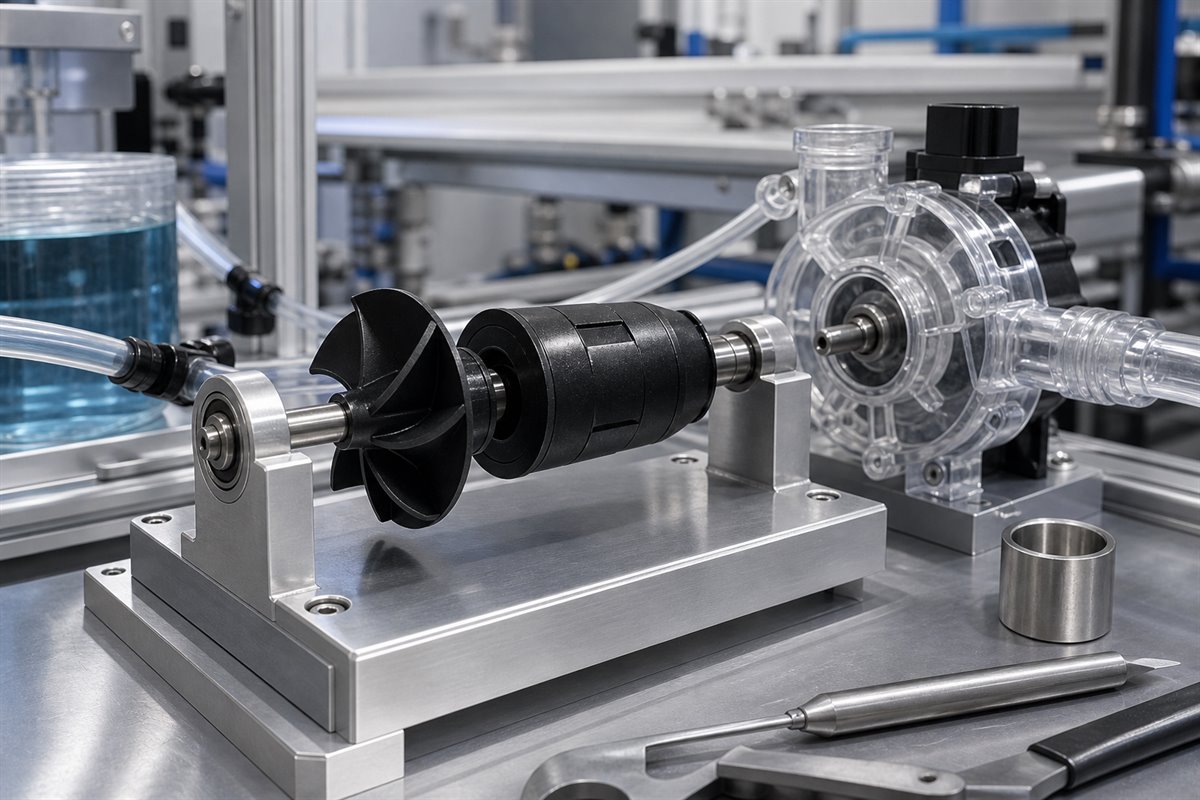
Dynamic Balance and Dimensional Control
A pump rotor must spin smoothly. Even when the magnetic material is correct, small errors in concentricity, shrinkage, insert position, or impeller geometry can create vibration, noise, and bearing stress. This is why molded magnetic rotor design should include dimensional control from the beginning.
Injection molded magnetic compounds can help because the rotor geometry and magnetic body can be formed in a controlled tool. Chase’s application data notes that precise dimensional control of injection magnets can support dynamic balance advantages for pump rotors. This advantage only becomes real when the tooling, process window, magnetization, and inspection plan are aligned.
For both Ferrite/PPS and NdFeB/PPS, define balance requirements before sampling. The supplier should know rotor speed, maximum allowed imbalance, shaft datum, bearing interface, and whether balance correction is allowed after molding.
How to Choose: Practical Decision Rules
Choose Ferrite/PPS when:
- The rotor has enough volume to meet magnetic output requirements
- Cost, corrosion resistance, and supply stability are important
- The application does not require maximum torque density
- The design values stable high-volume molding and reduced material risk
- Coolant exposure and long-life reliability are more important than compact size
Choose NdFeB/PPS when:
- The rotor must be smaller while maintaining torque
- Ferrite/PPS cannot meet startup torque or coupling requirements
- The magnetic gap or wall thickness is challenging
- Higher material cost is acceptable for better performance
- The project can support deeper validation for temperature and fluid exposure
In many programs, the best answer is found by testing both materials in the same rotor geometry. Measure magnetic output, pump performance, noise, vibration, temperature stability, and aging behavior. A spreadsheet comparison cannot replace a functional pump test.
Conclusion
Ferrite/PPS and NdFeB/PPS are both useful materials for cooling water pump rotors, but they serve different design priorities. Ferrite/PPS is often the practical choice for cost-effective, corrosion-resistant, high-volume pump rotor designs where magnetic volume is sufficient. NdFeB/PPS is useful when the pump needs higher magnetic output, compact size, or stronger coupling through a difficult magnetic path.
The right material should be selected from the finished pump requirement: torque, speed, coolant exposure, temperature range, rotor balance, shaft retention, dimensional stability, and production cost. For automotive thermal management systems, the winning rotor is not simply the strongest magnetic material. It is the material and process combination that survives validation and stays stable in production.
FAQ
Is Ferrite/PPS or NdFeB/PPS better for cooling water pump rotors?
Neither is automatically better. Ferrite/PPS is often attractive for cost, corrosion resistance, and stable high-volume production. NdFeB/PPS is useful when the rotor needs higher magnetic output or a more compact design. The right choice depends on torque requirement, air gap, temperature, coolant exposure, rotor structure, and validation results.
Why use PPS as the binder for pump rotor magnets?
PPS is commonly considered when a molded magnetic component needs heat resistance, dimensional stability, chemical resistance, and low moisture sensitivity. For cooling water pump rotors, the binder must be evaluated with the coolant, thermal cycling, shaft insert, and molding process.
Can the blade and magnetic rotor be molded as one part?
Yes, some pump rotor designs can integrate the blade and magnetic rotor by injection molding. Other designs mold the magnetic rotor first and use secondary injection or assembly for the impeller. The best route depends on balance, tooling, material compatibility, and service conditions.
What should be tested before choosing NdFeB/PPS?
NdFeB/PPS should be tested for magnetic output at temperature, demagnetization margin, coolant and humidity exposure, mechanical retention, dynamic balance, dimensional stability, and production consistency. The higher magnetic output must justify cost and reliability requirements.
What RFQ data should be sent for a custom cooling water pump rotor?
Send the pump architecture, rotor drawing, magnetic target, air gap, coolant type, operating temperature, speed range, shaft and insert requirements, balance requirement, annual volume, validation standard, and any current failure modes such as cracking, noise, low torque, or unstable flow.