

Plastic bonded neodymium magnets do not usually beat sintered NdFeB magnets in raw magnetic energy density. If the only target is maximum flux from the smallest possible magnet volume, sintered magnets often remain the stronger choice.
But many OEM parts are not won by raw magnetic strength alone. A magnet may need to fit into a thin carrier, align with a sensor IC, rotate at speed, avoid chipping during assembly, or combine magnetic function with a shaft, hub, rotor, or molded plastic structure. In those cases, plastic bonded neodymium magnets can beat sintered magnets because they solve the complete part problem, not just the material-grade problem.
This article explains where plastic bonded neodymium magnets make sense, where sintered magnets still win, and how OEM engineers can compare the two options for sensors, encoders, compact motors, pump rotors, and custom magnetic assemblies.
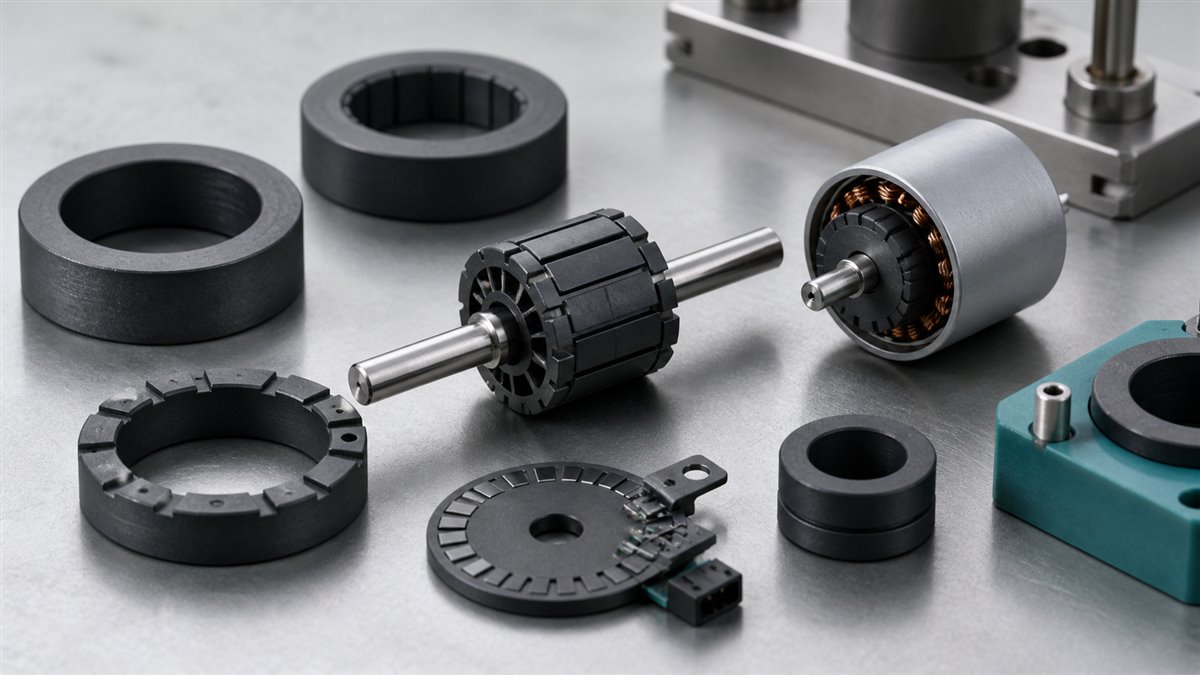
What Are Plastic Bonded Neodymium Magnets?
Plastic bonded neodymium magnets are made by combining NdFeB magnetic powder with a polymer binder. The compound is then formed by injection molding, compression molding, extrusion, or another bonded magnet process. In OEM components, injection molding and compression molding are the most common routes.
The polymer binder reduces the maximum magnetic loading compared with fully dense sintered NdFeB. That is why bonded neodymium magnets generally have lower remanence and energy product than sintered magnets. The tradeoff is manufacturing freedom. Bonded magnets can be produced in shapes, thicknesses, and integrated assemblies that are difficult or costly with brittle sintered magnet segments.
For a deeper process comparison, see the related guide on compression molded magnets vs injection molded magnets.
Where Sintered Magnets Still Win
Sintered NdFeB magnets are usually the first choice when the design requires the highest possible magnetic output in a simple magnet shape. They are dense, strong, and widely used in high-torque motors, magnetic couplings, holding systems, and compact magnetic circuits.
Sintered magnets are often best when:
- The magnet shape is simple, such as a block, disk, ring, or arc segment
- Maximum energy product is the main design constraint
- The assembly can tolerate adhesive bonding, sleeves, or mechanical retention
- Coating and corrosion protection can be managed reliably
- Chipping, cracking, and handling damage are controlled by the production process
In other words, sintered magnets are still excellent magnetic materials. The question is whether the finished OEM part needs more than material strength.
When Plastic Bonded Neodymium Magnets Beat Sintered Magnets
Plastic bonded neodymium magnets win when the part needs geometry, assembly integration, or production consistency that sintered magnets cannot easily provide. The advantage often appears at the system level: fewer parts, less adhesive, better alignment, lower breakage risk, and more repeatable magnetic output at the working position.
1. When the Magnet Needs Complex Geometry
Sintered magnets are strong but brittle. Complex details, thin ribs, small holes, molded keys, gear-like features, and snap-fit geometry are difficult to create economically. Plastic bonded neodymium magnets can be molded closer to the final shape.
This is useful for magnetic encoder rings, sensor targets, small actuator parts, and compact rotor components. Instead of designing a mechanical carrier around a separate magnet, engineers can make the magnetic component part of the carrier geometry.
2. When the Part Needs Multi-Pole Magnetization
Many sensor and encoder applications require a controlled pole pattern, not just a strong magnet. Plastic bonded neodymium magnets can be molded into rings, disks, or sleeves and then magnetized with multi-pole patterns using dedicated fixtures.
This can be valuable for rotary position sensing, angle sensors, gear position sensors, and small motor feedback systems. A single molded bonded magnet ring may replace multiple sintered segments that would otherwise need precise placement around a hub.
3. When Insert Molding Reduces Assembly Steps
Plastic bonded neodymium magnets can be molded around shafts, sleeves, hubs, carriers, or plastic support structures. This is one of the clearest ways they can outperform sintered magnets in OEM production.
A sintered magnet may require adhesive, mechanical clamping, or a retaining sleeve. A bonded magnet can sometimes integrate the magnetic material and the mechanical interface in one operation. That can reduce stack-up tolerance, manual placement, adhesive cure time, and inspection burden.
4. When Chipping or Cracking Creates Production Risk
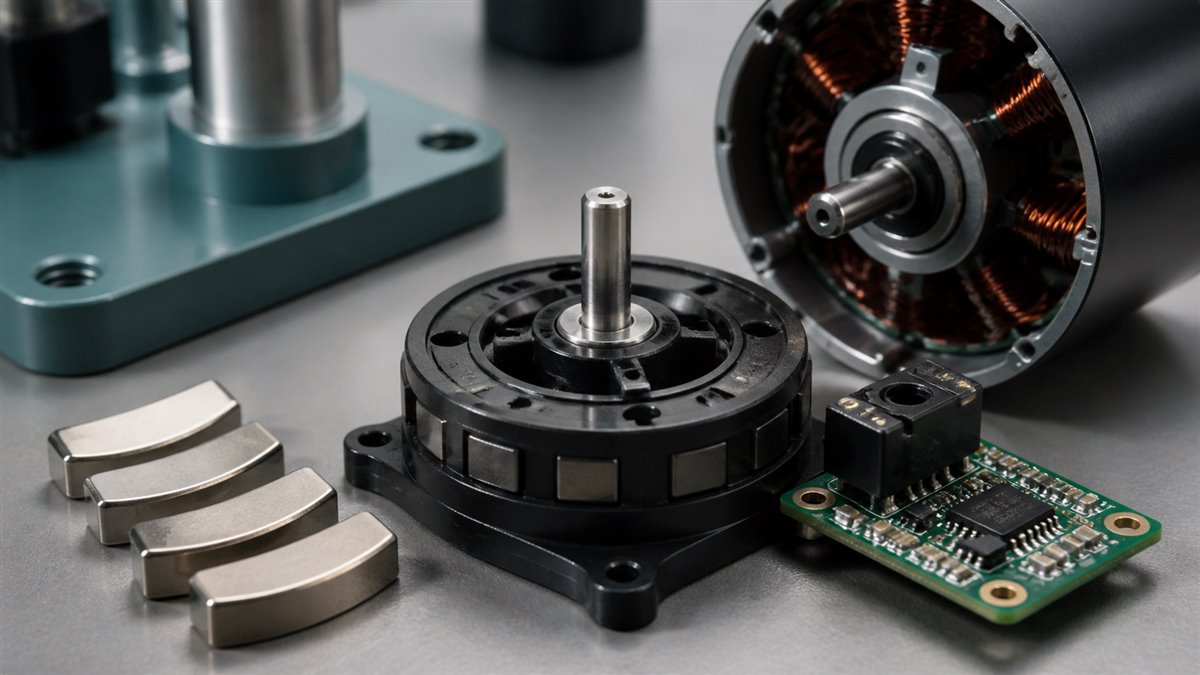
Sintered NdFeB magnets are hard and brittle. During handling, bonding, press fitting, or high-speed rotor assembly, edges may chip or parts may crack if the process is not carefully controlled. Plastic bonded magnets are generally less brittle because the polymer binder adds toughness.
This does not mean bonded magnets are mechanically unlimited. They still need proper resin selection, part thickness, gate design, and validation. But for small OEM components, reducing brittle-fracture risk can be a meaningful production advantage.
5. When Corrosion and Coating Risk Matter
Sintered NdFeB usually needs coating because the material is vulnerable to corrosion. Coating quality, edge coverage, adhesion, and damage during assembly can all affect long-term reliability.
Plastic bonded neodymium magnets embed the magnetic powder in a polymer matrix. Depending on the binder, powder system, and exposure environment, this can reduce some coating-related risks. For humid or chemically exposed assemblies, the final choice still needs application testing, but bonded magnets can simplify the protection strategy in selected designs.
6. When Total Assembly Cost Matters More Than Magnet Piece Price
Sintered magnets may look cheaper or stronger when comparing only one magnet piece. Plastic bonded neodymium magnets may look more expensive if tooling and compound development are included. But OEM cost should be calculated at the assembly level.
If bonded magnets reduce the number of parts, remove adhesive, simplify fixtures, reduce rejects, or shorten assembly time, they can lower the total cost of the finished product. This is especially true in high-volume sensor, rotor, pump, and small motor programs.
Plastic Bonded NdFeB vs Sintered NdFeB: Practical Comparison
| Decision Factor | Plastic Bonded Neodymium Magnets | Sintered Neodymium Magnets |
|---|---|---|
| Magnetic strength | Lower than sintered NdFeB, but strong enough for many sensors, rotors, and compact assemblies | Highest magnetic output for a given volume |
| Shape freedom | Excellent for molded rings, thin sections, hubs, carriers, and integrated details | Better for simpler shapes; complex geometry usually increases cost or risk |
| Multi-pole magnetization | Very suitable for molded rings, disks, and encoder targets | Possible, but segmented assemblies may add placement and fixture complexity |
| Mechanical toughness | Generally less brittle due to polymer binder | Hard and brittle; chipping and cracking must be controlled |
| Insert molding | Strong advantage for shafts, sleeves, hubs, carriers, and custom magnetic assemblies | Usually requires secondary assembly or retention design |
| Corrosion strategy | Polymer matrix can simplify protection in some environments | Usually requires coating and careful coating protection |
| Best-fit applications | Sensors, encoder rings, small rotors, pump rotors, integrated OEM parts | High-torque motors, compact magnetic circuits, simple high-flux magnets |
Key Design Tradeoffs
Magnetic Output vs Geometry
Plastic bonded neodymium magnets give up some magnetic density in exchange for shape control. If the design has enough volume for the bonded magnet to meet the required field, the geometry advantage may outweigh the lower material strength.
Tooling Cost vs Assembly Cost
Bonded magnet tooling and magnetizing fixtures require upfront development. That cost must be compared with the cost of assembling, bonding, coating, inspecting, and rejecting sintered magnet assemblies.
Material Grade vs Magnetic Waveform
For sensors and encoders, the waveform at the sensor is often more important than the magnet grade. Pole accuracy, runout, air gap, and magnetization fixture design should be specified early.
Prototype Data vs Production Data
A prototype that works once is not enough. OEM parts need repeatable production data: flux maps, dimensional capability, thermal cycling, vibration testing, and assembly process controls.
Final Recommendation
Use sintered NdFeB magnets when the application needs maximum magnetic strength in a simple, well-protected shape. Use plastic bonded neodymium magnets when molded geometry, multi-pole magnetization, insert integration, reduced assembly variation, or total system cost matter more than peak energy density.
The best decision is usually made at the assembly level. Compare the field at the working position, the number of assembly steps, the tolerance stack, the validation risk, and the cost of rejects. In many OEM parts, that is where plastic bonded neodymium magnets can quietly beat sintered magnets.
FAQ
Are plastic bonded neodymium magnets as strong as sintered neodymium magnets?
No. Sintered NdFeB magnets usually have higher magnetic energy density. Plastic bonded neodymium magnets can still be the better choice when molded shape, multi-pole magnetization, insert molding, or assembly repeatability is more important than maximum raw strength.
Why use plastic bonded NdFeB instead of sintered NdFeB?
Use plastic bonded NdFeB when the magnet needs complex geometry, thin features, integrated shafts or hubs, reduced chipping risk, or a controlled multi-pole pattern in one molded part.
Can plastic bonded neodymium magnets be used in motor rotors?
Yes. They are used in selected compact motor and actuator rotors where integrated geometry, balance, and production repeatability matter. Sintered magnets may still be preferred when maximum torque density is the main requirement.
Are bonded neodymium magnets good for sensor applications?
Yes. They can be very useful for angle sensors, encoder rings, Hall sensor targets, and gear position sensing because the molded magnet can control shape, pole pattern, and mechanical datum together.
Do plastic bonded neodymium magnets need coating?
It depends on the binder, magnetic powder, and operating environment. The polymer matrix can reduce some corrosion and coating concerns compared with sintered NdFeB, but humidity, temperature, and chemical exposure should still be validated.