

Strontium ferrite and barium ferrite magnets are both hard ferrite permanent magnets. They are widely used when engineers need a low-cost, corrosion-resistant, electrically insulating magnet material that can be produced in large volume. Compared with rare-earth magnets, ferrite magnets usually provide lower magnetic energy density, but they are stable, economical, and practical for many motors, sensors, rotors, magnetic assemblies, and holding applications.
The material names sound similar, and both are based on iron oxide chemistry. In OEM design, however, the choice should not be treated as a simple commodity substitution. Strontium ferrite and barium ferrite can differ in magnetic performance, coercivity, manufacturing availability, compliance documentation, and application fit. The right decision depends on what the finished part must do, how it will be manufactured, and how it will be validated.
This guide compares strontium ferrite vs barium ferrite magnets to help you decide which one fits your product requirements.
What Are Hard Ferrite Magnets?
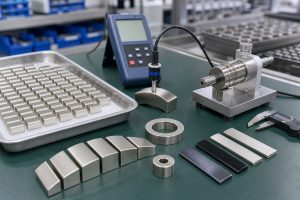
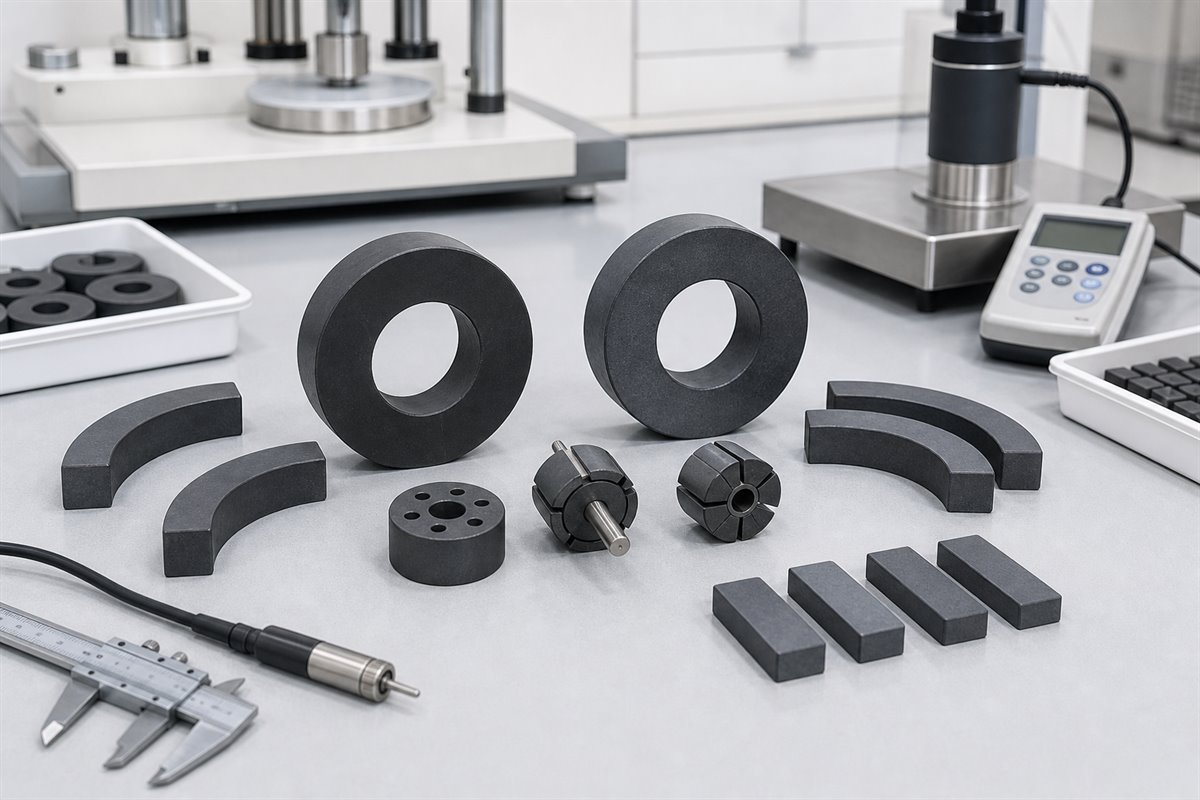
Hard ferrite magnets are ceramic permanent magnets made from iron oxide combined with alkaline earth elements such as strontium or barium. The two common families are strontium ferrite, often represented as SrFe12O19, and barium ferrite, often represented as BaFe12O19. Both belong to the M-type hexaferrite family and are used when a magnet must resist demagnetization under normal working conditions.
Ferrite magnets can be produced by different routes. Sintered ferrite magnets are made by ceramic powder processing and sintering. Bonded ferrite magnets mix ferrite powder with a polymer binder. Injection molded ferrite magnets use a ferrite-filled thermoplastic compound to create complex shapes, multi-pole rings, rotors, sensor components, and insert-molded assemblies.
Chase Technology works with ferrite materials across sintered, compression molded, and injection molded product families. In many OEM projects, the practical question is not only whether the magnet is strontium ferrite or barium ferrite. The more important question is whether the material, process, magnetization, and assembly design can meet the application requirement.
Quick Comparison: Strontium Ferrite vs Barium Ferrite
| Selection Factor | Strontium Ferrite Magnets | Barium Ferrite Magnets |
|---|---|---|
| Typical role in permanent magnets | Common hard ferrite choice for modern permanent magnet applications | Used in some legacy, flexible, and lower-demand ferrite applications |
| Coercivity and demagnetization resistance | Often stronger in practical hard ferrite grades | Can be adequate, but grade-specific performance must be checked |
| Cost position | Low-cost compared with rare-earth magnets; widely available | Also low-cost, but selection depends on supply chain and specification |
| Corrosion behavior | Excellent corrosion resistance because it is an oxide ceramic | Also excellent corrosion resistance as a ferrite ceramic |
| Manufacturing routes | Sintered, bonded, injection molded, compression molded depending on grade and design | Sintered, bonded, flexible, and selected specialty forms |
| Best-fit OEM logic | Choose when standard hard ferrite performance and volume production stability matter | Consider when a validated design already uses it or when its specific form fits the application |
Magnetic Performance: Do Not Compare by Name Alone
Many engineers ask whether strontium ferrite is stronger than barium ferrite. In common permanent magnet use, strontium ferrite is often selected because it can provide better coercivity and practical resistance to demagnetization than many barium ferrite grades. This is why strontium ferrite is widely used for hard ferrite magnets in motors, speakers, holding systems, and industrial components.
That said, a material name is not enough to select a magnet. Ferrite performance depends on powder quality, particle orientation, density, forming method, sintering or molding process, binder loading, and magnetization design. A well-made bonded strontium ferrite part and a sintered strontium ferrite part will not have the same properties. A low-grade strontium ferrite magnet may not outperform a properly specified barium ferrite part in every working condition.
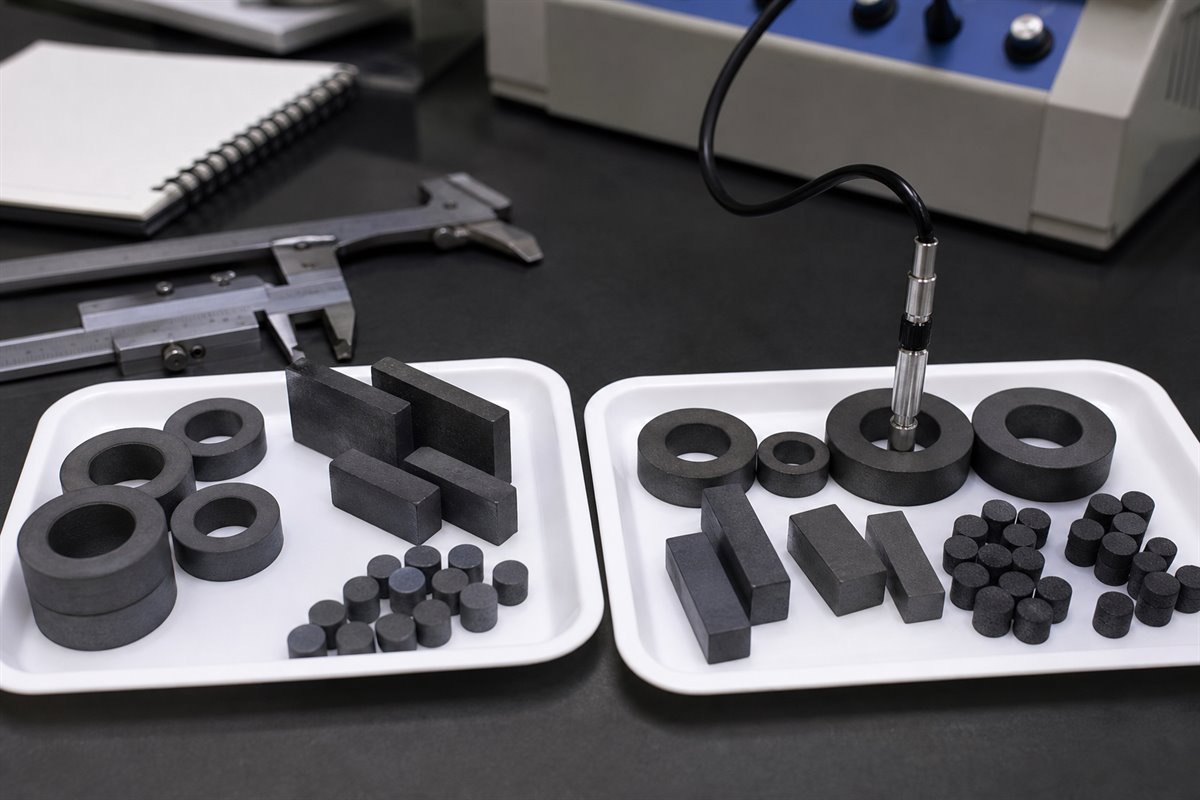
For custom parts, compare the actual datasheet values and application output. Important values include residual flux density Br, coercive force HcB, intrinsic coercive force HcJ, maximum energy product BHmax, density, temperature behavior, and measured flux at the real working distance. For a sensor ring, waveform at the sensor matters more than a generic surface gauss value. For a rotor, balance and mechanical stability matter alongside flux.
Corrosion, Temperature, and Mechanical Stability
One of the largest advantages of ferrite magnets is corrosion resistance. Because ferrites are oxide ceramic materials, they do not rust like uncoated sintered NdFeB. In many environments, ferrite magnets do not need nickel plating or epoxy coating. This can simplify cost, avoid coating failure modes, and make ferrite attractive for humid or chemically moderate environments.
Ferrite magnets also have good temperature stability for many cost-sensitive designs. Their magnetic output is lower than rare-earth magnets, but they can be useful where high temperature, corrosion resistance, electrical insulation, and low cost matter more than maximum energy density. However, sintered ferrite is brittle. It can chip under impact or crack under mechanical stress. Bonded and injection molded ferrite parts can improve geometry freedom and impact behavior, but their final performance depends on resin system and magnetic powder loading.
For molded ferrite components, the binder matters. PA6, PA12, PPS, and other thermoplastics influence temperature range, moisture absorption, dimensional stability, chemical resistance, and strength. In applications such as flow rotors, pump rotors, sensor rings, and appliance motor components, the polymer system can be just as important as the ferrite powder family.
Regulatory and Compliance Considerations
Material compliance should be treated as documentation work, not as a guess based on material name. Ferrite magnets are often attractive because they do not require rare-earth elements and may avoid some coating-related issues. Still, OEM buyers should request the supplier’s latest declarations for the finished magnet or magnetic assembly.
For products sold into regulated markets, check the current EU RoHS Directive, the ECHA REACH Candidate List, and any industry-specific requirements such as ELV, medical device requirements, food-contact rules, toy safety, or customer restricted substance lists. The exact compliance question may depend on the whole assembly, not only the ferrite powder. Inserts, coatings, adhesives, soldered sensor boards, plastic carriers, and packaging can all affect documentation.
Barium ferrite should not be rejected automatically just because it contains barium in the chemical formula. Barium ferrite is a stable ceramic compound and is different from soluble barium salts. But the word “barium” can trigger extra questions from purchasing, environmental, or customer compliance teams. If a project uses barium ferrite, make the documentation clear early: SDS, material declaration, restricted substance declaration, and test reports where required.
Application Fit: Where Each Ferrite Type Is Used
- Strontium ferrite is usually the default hard ferrite choice for many permanent magnet applications. It is commonly used in motor magnets, speaker magnets, holding magnets, ferrite rings, arc magnets, sensor targets, and molded magnetic assemblies. When a design needs reliable ferrite performance and volume production, strontium ferrite is often the first material family to evaluate.
- Barium ferrite can still be relevant in selected applications. It may appear in legacy designs, flexible magnets, simple holding magnets, and specialty magnetic materials. The decision should be based on the part’s measured magnetic output, available process route, cost target, supplier capability, and compliance package.
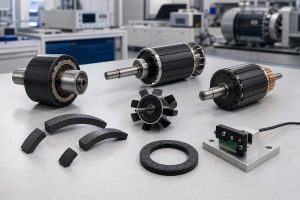
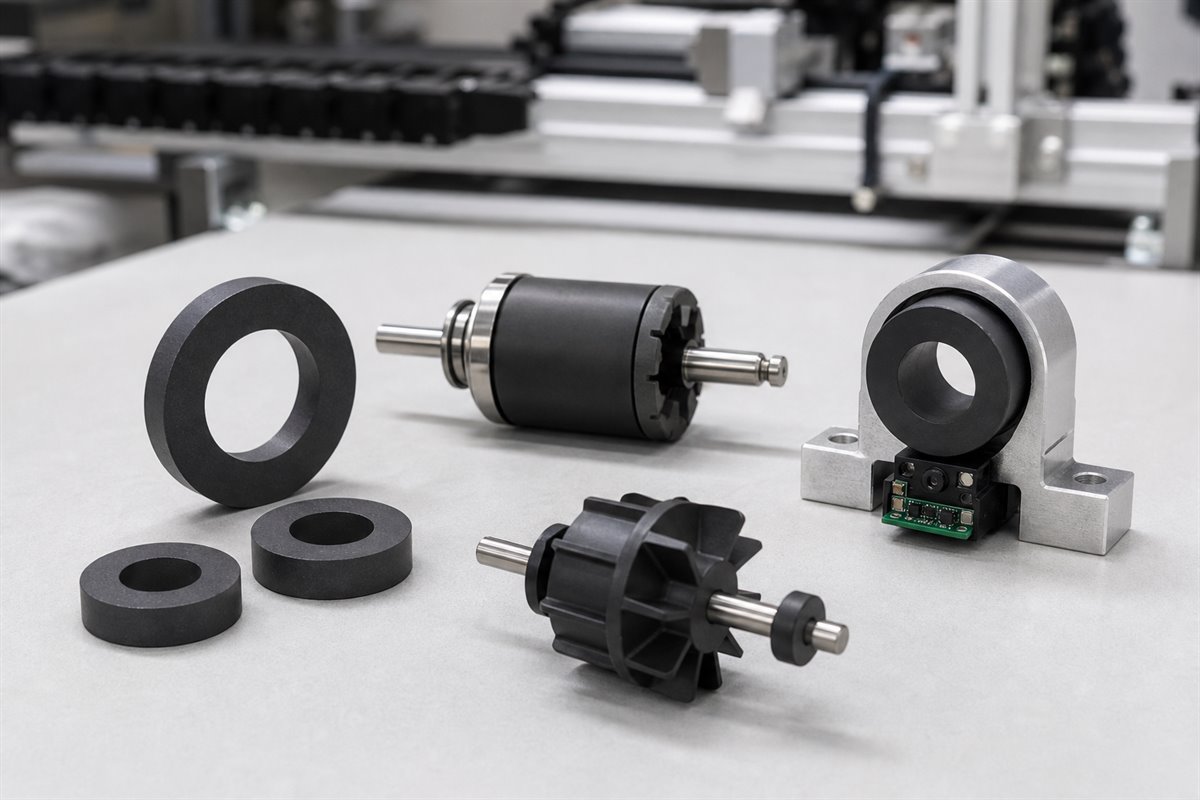
For Chase Technology’s application space, ferrite materials are especially relevant to injection molded and bonded magnetic components. Ferrite compounds are used in flowmeter induction rotors and industrial automation magnets, printer magnetic rollers, home appliance rotors, motor rotors, sensor rings, and pump rotor assemblies. These parts often need more than a simple block magnet. They need controlled geometry, multi-pole magnetization, insert features, or stable dimensions in volume production.
Process Choice: Sintered, Bonded, or Injection Molded Ferrite?
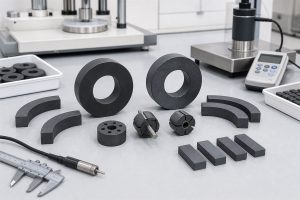
The Sr vs Ba question should be paired with process choice. A sintered ferrite magnet can provide a robust ceramic magnet for simple shapes such as blocks, rings, arcs, and tiles. A compression molded magnet can be useful when bonded ferrite or bonded NdFeB needs dimensional accuracy and stable output. An injection molded ferrite magnet is often chosen when the part needs geometry that would be difficult with sintered ceramic.
Injection molded ferrite is especially useful for:
- Multi-pole rings and sensor targets
- Motor rotors with integrated shafts, hubs, or sleeves
- Flow rotors and pump rotors with thin molded features
- Magnetic assemblies that require insert molding or overmolding
- High-volume parts where reducing assembly steps matters
The tradeoff is that injection molded ferrite usually has lower magnetic loading than sintered ferrite because the compound must flow through the tool. For many sensors and rotors, this is acceptable because shape control and assembly repeatability are more important than maximum magnetic energy. For applications that need the highest ferrite output from a simple shape, sintered ferrite may still be better.
Related article: How Permanent Magnets Are Manufactured
How to Choose Between Sr Ferrite and Ba Ferrite
A practical selection process starts with the application, not the material name. Use the following steps:
- Define the working function. Is the magnet generating torque, sensing position, holding a part, producing a waveform, or acting as a rotor?
- Set magnetic requirements. Specify flux density, waveform, pole count, air gap, demagnetization exposure, and temperature range.
- Select the manufacturing route. Decide whether the shape is best suited to sintering, compression molding, injection molding, or a full magnetic assembly.
- Compare actual grade data. Review Br, HcB, HcJ, BHmax, density, and temperature behavior rather than relying on the Sr or Ba label.
- Review compliance documents. Ask for SDS, RoHS, REACH, customer substance declarations, and any market-specific documentation.
- Validate in the real assembly. Measure the field or waveform at the working air gap, check dimensions, and test the part under temperature, humidity, vibration, and mechanical load.
If the part is a modern OEM permanent magnet and no legacy requirement exists, strontium ferrite is often the stronger starting point. If the design already uses barium ferrite successfully, do not change it only for naming preference. First compare output, supply stability, compliance, cost, and process risk.
Conclusion
Strontium ferrite and barium ferrite magnets are both useful hard ferrite materials, but they should be selected through application requirements rather than material names alone. Strontium ferrite is often the preferred starting point for modern hard ferrite permanent magnets because of its practical magnetic performance and broad availability. Barium ferrite can still be appropriate for certain legacy, flexible, low-cost, or specialty uses.
For OEM engineers, the better question is: which ferrite material and manufacturing route will deliver the required field, waveform, geometry, stability, compliance, and cost in production? Once that question is answered, the choice between Sr ferrite and Ba ferrite becomes a controlled engineering decision instead of a catalog comparison.
FAQ
Is strontium ferrite stronger than barium ferrite?
In many permanent magnet applications, strontium ferrite grades offer higher coercivity and better resistance to demagnetization than older barium ferrite grades. Exact performance still depends on the powder, orientation, density, binder system, magnetization, and manufacturing process.
Are barium ferrite magnets unsafe because they contain barium?
Barium ferrite is a stable ceramic compound, not the same as soluble barium salts. For OEM use, buyers should still request SDS, RoHS, REACH, and application-specific compliance documentation from the supplier, especially for consumer, automotive, medical, or regulated products.
When should engineers choose strontium ferrite magnets?
Choose strontium ferrite when the part needs reliable hard ferrite performance, good coercivity, cost control, corrosion resistance, and stable production for motors, sensors, rotors, speakers, holding magnets, and injection molded or sintered ferrite assemblies.
When does barium ferrite still make sense?
Barium ferrite can make sense for legacy designs, low-cost applications, flexible magnetic materials, or programs where the existing magnetic specification is already validated. It should be compared by measured magnetic output and compliance requirements, not by material name alone.
Can ferrite magnets be injection molded?
Yes. Ferrite powder can be compounded with thermoplastic binders such as PA or PPS and processed as injection molded ferrite magnets. This is useful for complex shapes, multi-pole rings, rotors, sensor magnets, and insert-molded magnetic assemblies.