

You can hold two ring magnets that look identical and still get completely different magnetic behavior. The reason is often the magnetization direction. One ring may have poles on its flat faces. Another may have them on opposite sides.
A diametrically magnetized ring magnet is a circular magnet with a center hole and a single north-south pole pair arranged across its diameter. The magnetization direction is perpendicular to the hole axis. In simple terms, the north pole sits on one curved side, and the south pole sits on the opposite curved side.
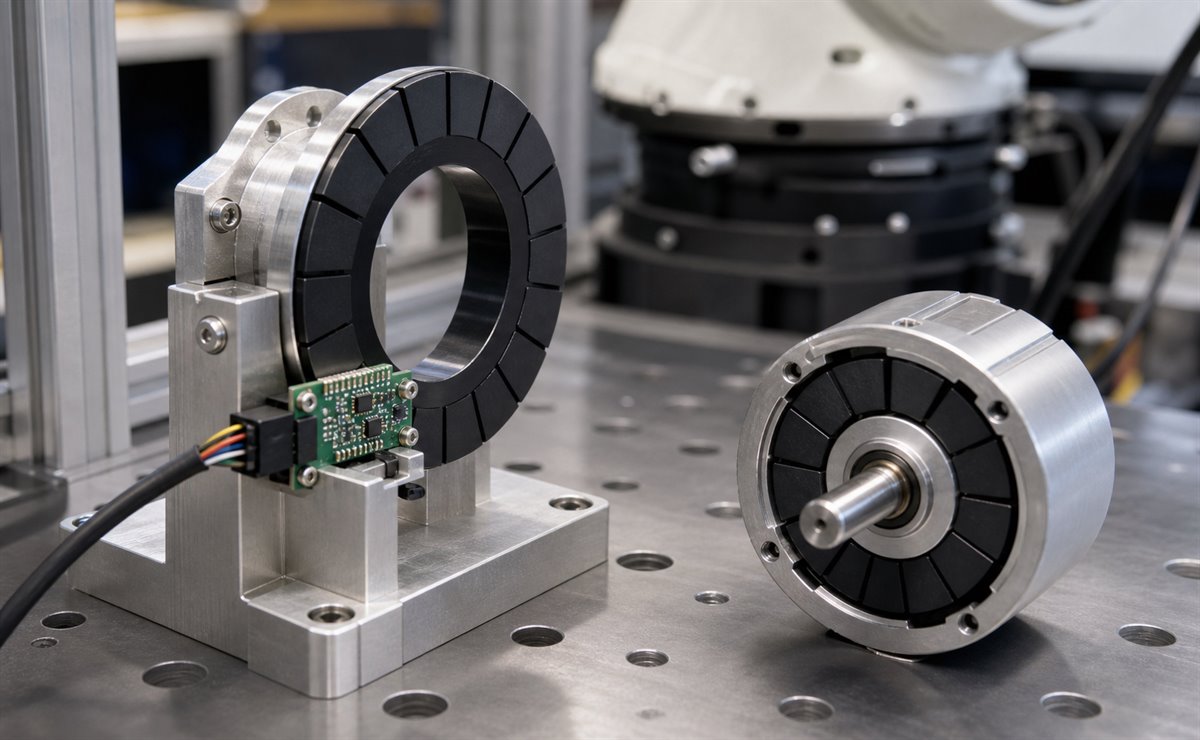
This side-to-side field is useful when the ring rotates around a shaft. A compatible magnetic sensor can track the rotating field direction and calculate angle. The hole leaves space for a shaft, fastener, bearing, or other mechanical feature.
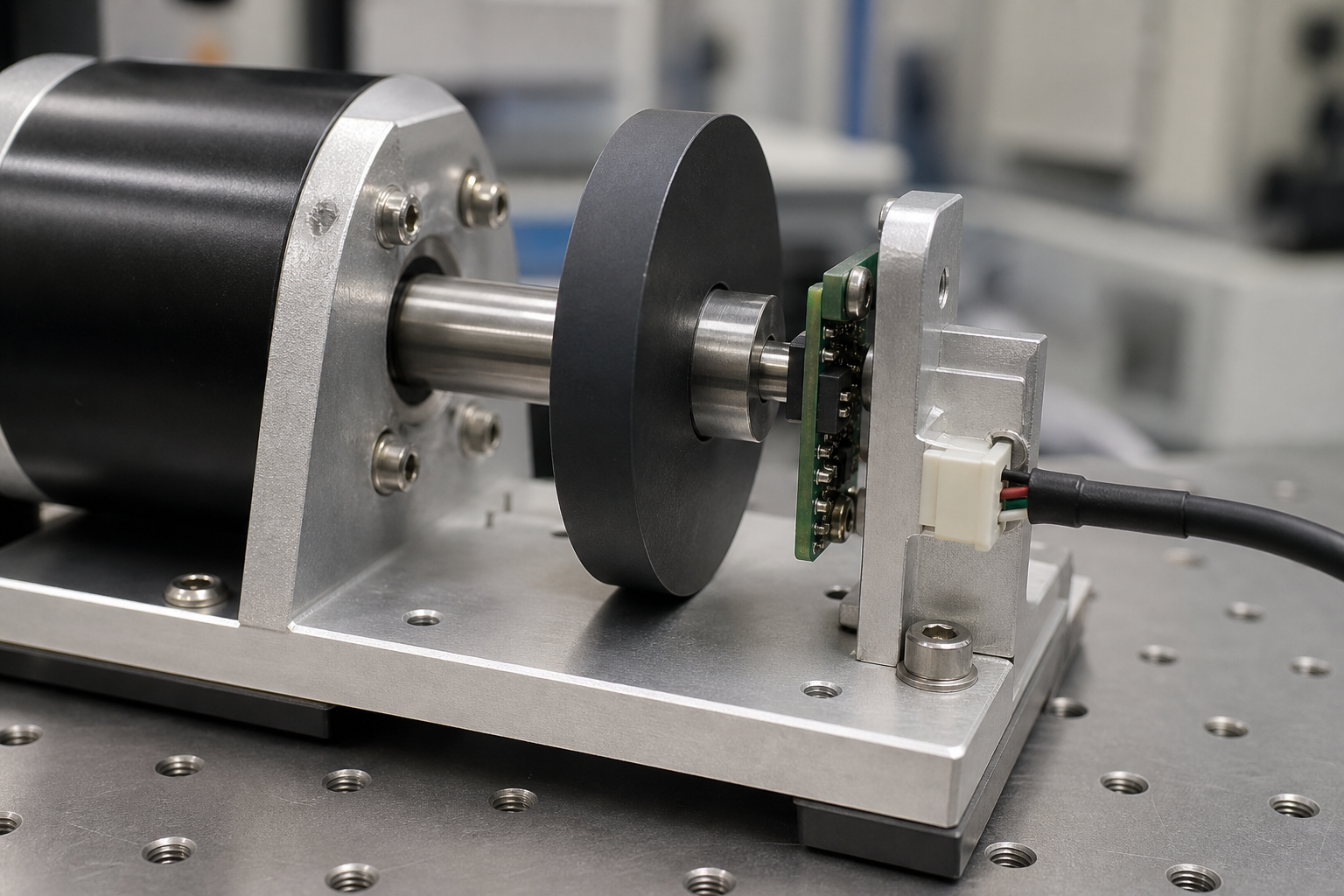
How Does a Diametrically Magnetized Ring Magnet Work?
Start with the ring’s geometry. Its central axis runs through the hole. In an axial ring magnet, the magnetization follows that axis. In a diametric ring, the magnetization crosses the ring from one side of the outside diameter to the other.
That creates one north pole and one south pole around the circumference. As the ring turns, the field vector turns with it. A two-axis or three-axis Hall, AMR, GMR, or TMR sensor can measure components of that field. The electronics then calculate the angular position, often with an arctangent function.
Diametric vs Axial vs Radial Ring Magnetization
These terms are easy to mix up, so it helps to picture where the poles sit.
| Magnetization type | Typical pole location | Common use |
|---|---|---|
| Diametric | Opposite curved sides of the ring | Absolute angle sensing and rotating field targets |
| Axial | Opposite flat faces | Holding, attraction, proximity sensing, and axial magnetic circuits |
| Radial | Inner and outer cylindrical surfaces, depending on the design | Motor and coupling fields |
| Multipole axial or radial | Alternating poles around a face or circumference | Speed, incremental position, commutation, and encoder tracks |
A diametric ring usually has one pole pair. A multipole ring has several alternating north and south poles. That distinction matters. A single pole pair can represent one absolute 360-degree mechanical revolution. A multipole track creates repeated cycles and usually needs additional information to identify the unique mechanical angle.
If your application needs many magnetic transitions per turn, read our multipole magnetic encoder ring guide. It explains axial and radial tracks in more detail.
Why Use a Diametrically Magnetized Ring Magnet?
- It Leaves the Shaft Center Open: A solid disc often sits on the end of a shaft. A ring can slide over the shaft or sit around another central feature. This helps when the shaft end is unavailable, the product is thin, or the assembly needs a pass-through bore.
- It Supports Contactless Absolute Angle Sensing: The field direction changes continuously as the ring rotates. A suitable angle sensor can read that direction without gears, brushes, or physical contact. This is useful in knobs, valves, actuators, robot joints, motor feedback, throttle or pedal mechanisms, and other rotating controls.
- It Can Work in On-Axis or Side-Shaft Layouts: In an on-axis layout, the sensor is centered above or below the rotating magnet. This is usually the simplest path to a uniform signal. A ring also permits side-shaft or in-hole sensing layouts. Those arrangements save space, but they need closer field simulation and calibration.
Common Diametrically Magnetized Ring Magnet Applications
- Rotary angle sensors: measuring absolute shaft position through one full turn.
- Control knobs and human-machine interfaces: detecting knob angle without a mechanical potentiometer.
- Valves and actuators: reporting flap, lever, or valve position in sealed systems.
- Motor and robot feedback: fitting an angle target around a shaft when the shaft end is occupied.
- Medical and laboratory mechanisms: enabling contactless position feedback in compact rotating devices.
- Custom magnetic assemblies: integrating a two-pole ring with a hub, insert, sleeve, or molded carrier.
The ring is not automatically the right choice for every encoder. If you need high incremental resolution or motor commutation with many electrical cycles per revolution, a multipole ring may fit better. Our comparison of a rotary angle sensor and rotary encoder can help clarify the signal requirements first.
How to Specify a Diametric Ring Magnet
Define the Ring Geometry
Specify the outside diameter, inside diameter, thickness, chamfers, and dimensional tolerances. Include runout and concentricity relative to the shaft datum. The hole changes the magnetic circuit, so a ring should not be treated as a solid cylinder with material removed at the last minute.
Call Out the Magnetization Clearly
Write “diametrically magnetized, one pole pair” on the drawing. Add a pole orientation or angular index relative to a key, flat, notch, or assembly feature when zero position matters. Define the allowed magnetization-angle tolerance. A simple north-pole mark can prevent mistakes during assembly and inspection.
Select the Material for the Real Environment
Sintered NdFeB provides strong output in a compact size. It may need a protective coating and careful mechanical support. SmCo is useful when temperature stability and corrosion resistance justify a higher material cost. Bonded NdFeB or ferrite can support precise geometry, tougher edges, integrated features, and production-friendly molding, although magnetic output is lower than comparable sintered NdFeB.
Specify the Field at the Sensor
Surface gauss alone does not define sensor performance. State the sensor location, minimum and maximum air gap, required field components, amplitude range, orthogonality, harmonic limits, and angle-error target. Include shaft offset, tilt, thermal movement, and bearing play in the tolerance stack.
Common Design Mistakes to Avoid
- Ordering the right shape with the wrong magnetization. Most standard rings are axial, so never rely on the word “ring” alone.
- Ignoring the angular pole index. The sensor zero may shift if the pole direction is not tied to a mechanical datum.
- Checking only peak field. Angle accuracy also depends on field balance, phase, harmonics, and the sensor’s calculation method.
- Placing the sensor off-axis without simulation. A side-shaft layout can work, but its raw output may be nonlinear.
- Forgetting assembly tolerances. Eccentricity, tilt, runout, and air-gap change can create more error than the magnet material itself.
- Choosing the strongest grade by default. Temperature, corrosion, coating, molding, cost, and magnetizing feasibility all affect the better choice.
Before tooling, simulate the complete magnet, shaft, housing, and sensor position. Chase Technology’s magnetic simulation capability can compare geometry and tolerance cases before parts are cut.
How Are Diametrically Magnetized Ring Magnets Tested?
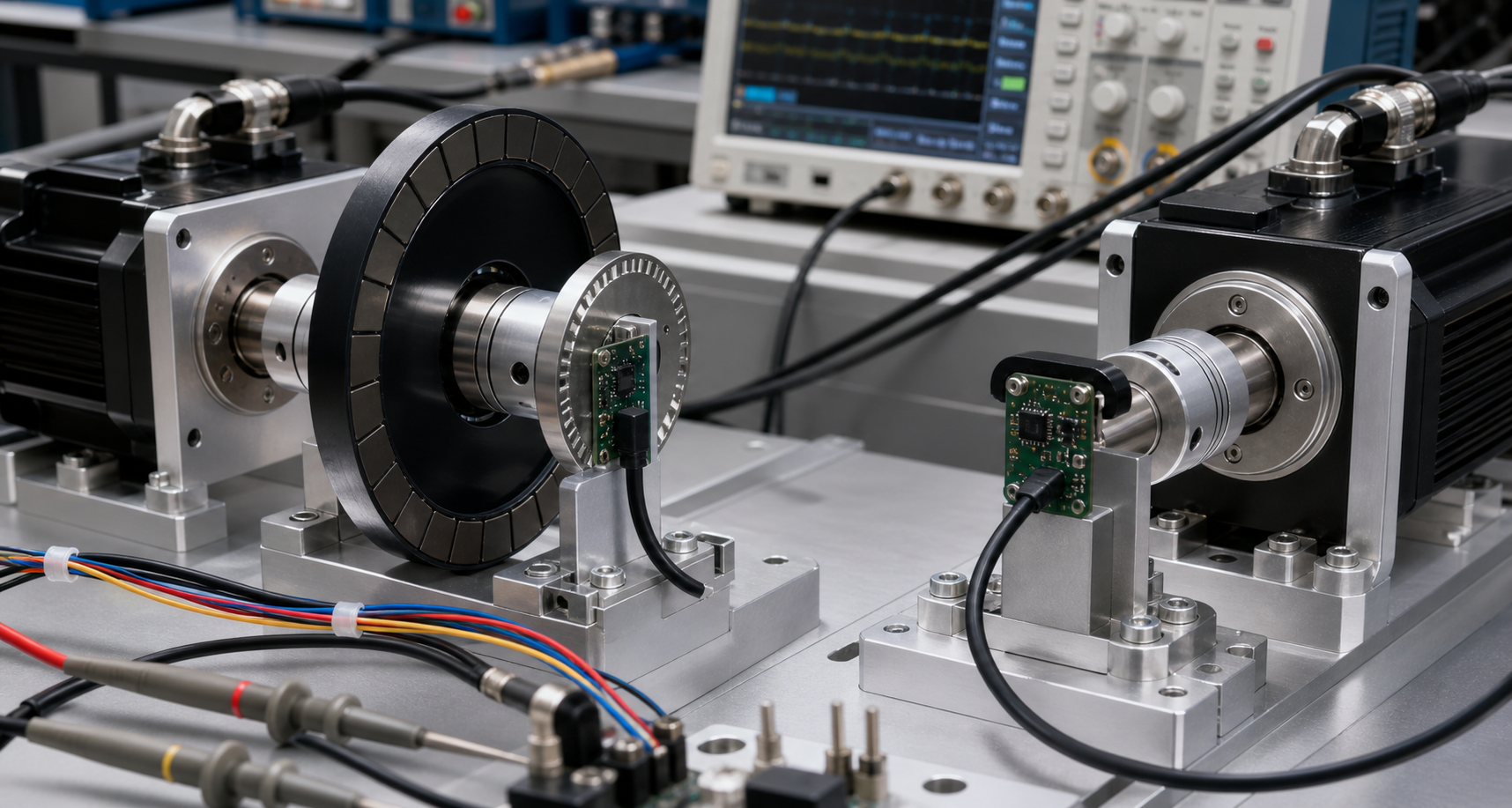
Basic inspection confirms dimensions, coating, pole count, and pole orientation. Application-level inspection goes further. A fixture rotates the ring or sensor at the specified air gap and records the relevant field components or calculated angle. The test can reveal amplitude imbalance, angular offset, harmonic distortion, eccentricity sensitivity, and weak regions.
For an assembled part, test the ring after bonding, overmolding, press fitting, or magnetization. Mechanical stress, steel nearby, and position error can change the result. Final inspection should use the same datum and sensing path defined on the customer drawing.
Need a ring that fits a shaft and works with a real sensor, not just a drawing note? Send Chase Technology the ring dimensions, pole index, sensor data sheet, air-gap range, temperature, speed, target accuracy, annual volume, and assembly layout. We can review material, magnetization, tooling, simulation, and inspection together. If you have a project in mind, we’d like to hear about it. Get in touch.
FAQs
Where Are the Poles on a Diametrically Magnetized Ring Magnet?
The north and south poles are on opposite curved sides of the ring. The magnetization crosses the diameter and is perpendicular to the central hole axis.
Is a Diametric Ring the Same as a Radially Magnetized Ring?
No. A diametric ring has a single side-to-side magnetization direction. A radially magnetized ring typically has magnetization directed between its inner and outer cylindrical surfaces. Multipole radial rings alternate pole directions around the circumference.
Can a Diametric Ring Measure 360-Degree Angle?
Yes. A compatible multi-axis magnetic sensor can follow the rotating two-pole field and calculate absolute angle through one mechanical revolution. Accuracy depends on alignment, air gap, field quality, sensor choice, and calibration.
Can an Existing Axial Ring Be Remagnetized Diametrically?
Usually, this should not be assumed. Material orientation, part geometry, coating, magnetizing-field strength, and fixture design may make remagnetization impractical or produce poor results. Specify the direction before production and validate it with the manufacturer.